A Forensic Analysis of Cult Psychology, Behavioral Manipulation, and Propaganda
—
Introduction
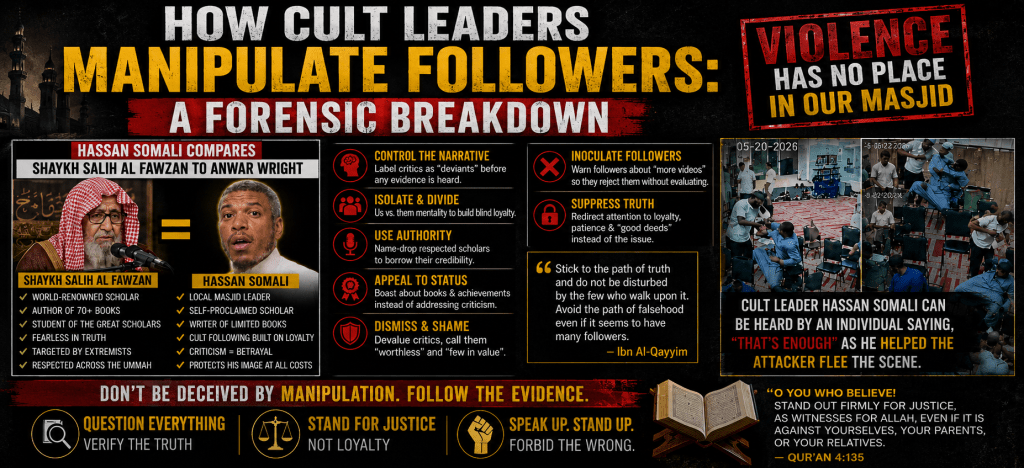
One of the oldest tactics used by cult leaders and authoritarian movements is not simply defending a leader—it is elevating that leader by placing him alongside respected authorities. The goal is psychological rather than evidential. Instead of answering criticism with facts, the audience is encouraged to transfer the honor, credibility, and emotional respect they have for a widely recognized scholar onto a local leader facing controversy.
This essay analyzes the rhetoric used by Hassan Somali in his public defense of Anwar Wright. The analysis is not concerned with judging motives. Rather, it examines the communication techniques, psychological influence strategies, and persuasion methods used in the speech. The focus is whether the arguments encourage objective evaluation or whether they redirect listeners toward loyalty, emotion, and authority.
—
1. The False Comparison
The first major tactic is comparing Anwar Wright to Mufti Shaykh Dr. Ṣāliḥ al-Fawzān.
Immediately, the frame of the discussion changes.
Instead of asking:
“Did Anwar Wright respond correctly to the allegations?”
The audience is encouraged to ask:
“Didn’t Shaykh al-Fawzān also have critics?”
These are completely different questions.
This is known as false equivalence.
Mufti Shaykh Dr. Ṣāliḥ al-Fawzān is an internationally recognized scholar whose reputation was established over decades of scholarship, teaching, and service to the Ummah.
Anwar Wright is a local religious leader responding to specific allegations.
Comparing the two encourages listeners to borrow the credibility of one man in order to shield another from scrutiny.
—
2. Borrowed Authority
Rather than presenting direct evidence defending Anwar Wright’s conduct, Hassan Somali repeatedly invokes respected names:
• Mufti Shaykh Dr. Ṣāliḥ al-Fawzān
• Ibn al-Qayyim
• The Salaf
• Great scholars
Psychologically, this creates an association.
Respected scholar = respected leader.
This is known as authority transfer.
Instead of proving the argument, the speaker attempts to borrow credibility from highly respected figures.
—
3. Redirecting the Conversation
The criticism concerns Anwar Wright’s behavior.
Instead of addressing the evidence directly, the speech shifts attention toward:
• ISIS
• Takfīr
• Extremists
• Online enemies
• Great scholars
• Famous books
The audience is emotionally redirected away from the original issue.
This is called topic displacement.
—
4. Creating a Persecution Narrative
The speech repeatedly suggests that righteous people are always criticized.
This produces a powerful psychological effect.
Followers begin believing:
“If our leader is criticized…
then he must be upon the truth.”
This reverses the normal process of reasoning.
Instead of evidence determining truth…
Opposition itself becomes proof of truth.
This is one of the defining characteristics found in many high-control groups.
—
5. Inoculating Followers Against Criticism
Hassan Somali repeatedly says:
“They’ll make ten more videos.”
“They’ll keep talking.”
“They’re worthless.”
Psychologists call this inoculation theory.
Followers are conditioned before hearing opposing evidence.
Instead of asking:
“Is the criticism true?”
They ask:
“Is this just another attack Hassan warned us about?”
Critical thinking becomes replaced by automatic loyalty.
—
6. Devaluing Critics
The speech labels critics as:
“Worthless.”
“Few in value.”
This is an important manipulation tactic.
If critics can be portrayed as morally inferior…
their evidence never has to be examined.
Healthy communities evaluate evidence.
Cult-like communities evaluate loyalty.
—
7. Replacing Evidence With Credentials
Rather than discussing the allegations…
the speech highlights:
Books.
Translations.
Teaching.
Years of work.
Scholarship.
Achievements.
None of these answer the actual allegations.
Past accomplishments do not determine whether present actions are correct.
This is known as an appeal to authority and credential substitution.
—
8. Loyalty Over Truth
Throughout the speech, one message repeatedly appears.
Remain patient.
Stay firm.
Ignore the critics.
Protect the leader.
Notice what is missing.
There is no repeated call to:
Investigate.
Verify.
Question.
Examine.
Truth welcomes investigation.
Personality-driven movements discourage it.
—
9. Emotional Framing
The speech repeatedly invokes emotionally charged examples.
ISIS.
Death threats.
Enemies.
Hatred.
Extremists.
Virality.
Behavioral science shows that when emotional arousal increases, analytical reasoning often decreases.
Emotion begins replacing evidence.
—
10. Social Identity Manipulation
The speech creates a strong division between:
Us.
Them.
People of truth.
People of falsehood.
This strengthens group identity.
Eventually followers begin believing that criticizing the leader means betraying the group itself.
This is a classic feature of high-control organizations.
—
11. Making the Leader Immune to Accountability
Followers are conditioned to believe:
Ignore criticism.
Ignore videos.
Ignore allegations.
Ignore evidence.
When followers have already been conditioned to distrust all outside criticism, accountability becomes nearly impossible.
—
12. Mixing Religion With Leader Protection
The speech uses authentic Islamic reminders about patience, steadfastness, sincerity, and perseverance.
These are genuine Islamic principles.
However, when those principles are applied in a way that discourages scrutiny of a particular leader, they can function as persuasive tools that redirect loyalty toward a person instead of objective truth.
—
13. Behavioral Science Analysis
From a behavioral science perspective, the speech demonstrates several well-known influence techniques:
• Authority transfer
• False equivalence
• Inoculation against criticism
• Emotional priming
• Identity fusion
• Topic displacement
• Credential substitution
• Loyalty framing
• Out-group derogation
None of these techniques alone prove that a movement is a cult.
However, together they are frequently discussed in the literature on authoritarian leadership, persuasion, and high-control groups. Their presence should encourage careful examination of whether followers are being guided toward evidence-based reasoning or toward loyalty-based thinking.
—
Conclusion
The issue is not whether respected scholars have faced criticism. Throughout Islamic history, sincere scholars have indeed been criticized, opposed, and even persecuted.
The question is whether invoking those examples meaningfully addresses the specific concerns raised about a contemporary local leader.
Comparing Mufti Shaykh Dr. Ṣāliḥ al-Fawzān to Anwar Wright shifts attention away from the evidence and toward emotion, identity, and authority. When appeals to authority, persecution narratives, credential lists, and dismissive characterizations of critics replace direct engagement with the underlying issues, the discussion moves away from objective evaluation.
Islam commands believers to stand firmly for justice and truth, even when it is against themselves, their families, or those they respect. Genuine scholarship is strengthened by transparency and evidence, not by discouraging scrutiny.
The lesson for every Muslim is simple:
Evaluate arguments by their evidence—not by personalities, comparisons, emotional appeals, or group loyalty. Truth does not fear examination. It is clarified through it.






Leave a Reply