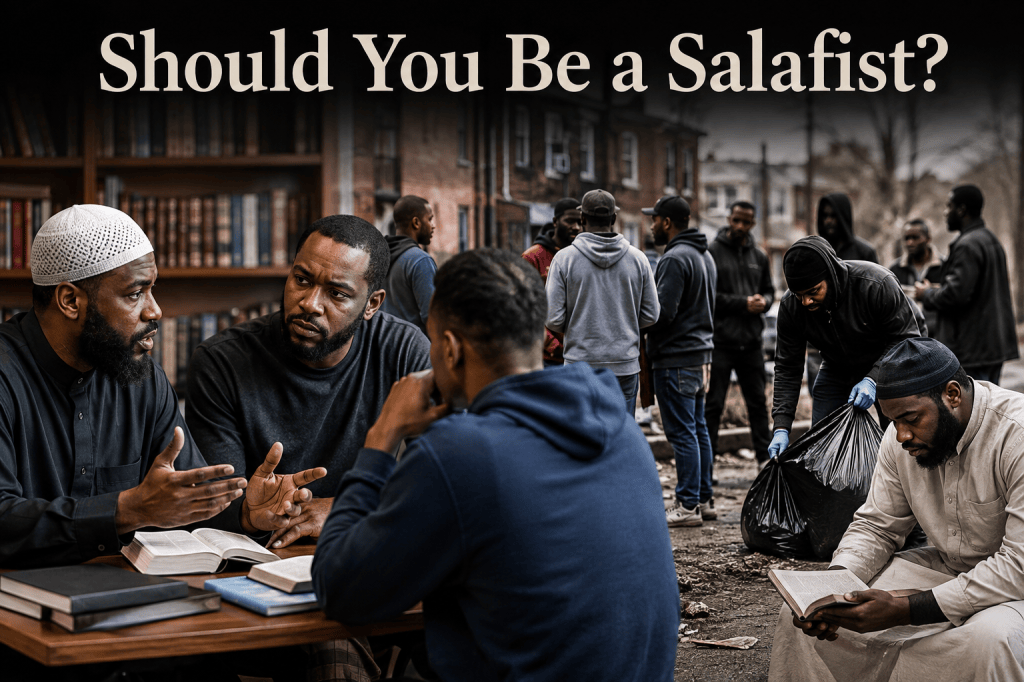
Having knowledge of the religion and knowledge of the world around us is extremely important when dealing with Black social issues. Along with having knowledge of Islam, it is equally important to understand the social issues and the social context of the people to whom you are giving da’wah.
If we are calling Black people to Islam as a remedy and solution for the social ills and dysfunctions that plague Black America and, more broadly, American society, then we have to understand both the people and the problems we are addressing.
Recently, a brother wrote a book addressing Black American Muslims and issues related to the Salafis. I am not going to mention his name, but those who know, know.
I have interviewed this brother in the past. Privately, he has also asked me questions about the religion, including questions related to marriage and fiqh, and I gave him what I considered sound advice based upon Islamic fiqh and Sharīʿah.
This same author has argued that the Salafis are apolitical and therefore do not have solutions for Black Americans.
I will acknowledge something from my own experience. I have been part of the Salafi community for close to 28 years. It was part of my journey to Islam and my true introduction to Islamic fiqh and serious, disciplined study. My experience with the Salafi da’wah encouraged me to seek knowledge seriously and eventually travel overseas to study.
For that reason, I recognize one of the important contributions of the Salafi da’wah: calling people to learn the religion properly and emphasizing the importance of seeking knowledge.
However, unfortunately, there is a segment of the Black American Muslim community that identifies as Salafi but is also plagued by self-hatred. Some have attempted to distance themselves from their Black identity and ignore many of the social issues affecting Black American Muslims and the broader Black American community—politically, socially, economically, and psychologically.
There is also a particular group that this brother is attempting to address in his book. In my view, many of the people in this particular group are not truly representative of Salafiyyah. I would describe them as pseudo-Salafis.
Their behavior can resemble a cult-like environment.
They are not addressing the actual social problems affecting Black American Muslims. Instead, they preserve the group, elevate the status of its leaders, defend the group’s internal hierarchy, and argue and fight—sometimes literally and physically—with people who are not part of their circle.
That kind of behavior is destructive to the Black Muslim community.
You can see examples of these kinds of problems in places such as Germantown Masjid in Philadelphia.
Now, I am not going to say whether the brother’s book is good or bad. I am not reviewing his book here.
What I will say is that, based upon my previous interactions with him, I do not believe he is qualified to speak authoritatively about certain areas of Islam.
I see many brothers involved in da’wah today. Many have Islamic da’wah networks and are interacting with other Black American Muslims while attempting to address important social problems.
But there is something I believe is extremely important:
You cannot effectively deal with social issues in the Black community without having a strong foundation in the Islamic sciences.
Let me give you an example.
As I mentioned earlier, this same author previously asked me privately for advice concerning marriage. The question he asked demonstrated to me that he did not have a strong foundation in the fundamentals of Islamic fiqh related to usrah (family), zawāj (marriage), and the Islamic family structure.
This was not a complicated or obscure issue. It was a basic question of Islamic jurisprudence.
That illustrates a larger problem:
How can we develop Islamic solutions for the community if we do not first understand the fundamentals of the religion?
I have also corrected this brother on other occasions concerning statements he made about the religion, including statements related to Ṣaḥīḥ al-Bukhārī and the scholars of Islam.
There is a common misconception that if something is found in Bukhārī, there is no further discussion or examination.
That demonstrates a lack of understanding of the sciences of Islam.
There are entire Islamic sciences dedicated to examining hadith. Scholars scrutinize the narrators, the chain of transmission, the narration itself, the reliability of the narrators, and other factors relevant to determining the authenticity and meaning of a hadith.
There is a science called muṣṭalaḥ al-ḥadīth, the science of hadith terminology and methodology.
There is also the science of jarḥ wa-taʿdīl, which deals with evaluating narrators.
There is fiqh.
There are the principles of fiqh.
There are the sciences of Qur’an.
There are the sciences of Sunnah.
There is Arabic language.
There is usūl.
There are numerous disciplines that a serious student of knowledge must study.
If someone does not have a foundation in these Islamic sciences, how can that person claim to provide comprehensive Islamic solutions to the social problems of the Black community?
This is not about attacking someone’s book or insulting someone’s writing.
It is about a fundamental principle:
Islamic solutions must actually be grounded in Islamic knowledge.
I have noticed that today, among some Black American Muslims, we often push the cart before the horse.
People want to solve social problems before developing a solid foundation in Islam.
They want to become community leaders before becoming serious students of knowledge.
They want to address Islamic family problems without studying Islamic family law.
They want to discuss Islamic governance without studying the principles of governance in Islam.
They want to discuss hadith without studying the sciences of hadith.
They want to discuss social problems without understanding either the Islamic framework or the social sciences necessary to understand those problems.
There are different stages in the development of communities.
One stage we often see among Black American Muslims is the brotherhood stage: brothers trying to help people get off drugs, keep young Black men out of prison, find people jobs, clean up the community, establish brotherhood, and provide support for people struggling with difficult circumstances.
These are all good things.
But I have observed over more than 20 years as a Muslim that many communities have started this way.
They begin with good intentions, strong brotherhood, activism, and community service.
But because they did not develop a strong foundation in Islamic knowledge, they did not prioritize seeking ʿilm, and they did not develop qualified scholars and students of knowledge, many of these communities eventually failed to maintain themselves.
Why?
Because when a community lacks knowledge, sound leadership, education, and institutional foundations, it becomes vulnerable.
It can become vulnerable to deviant ideologies.
It can become vulnerable to personalities.
It can become vulnerable to cult-like leadership.
It can become vulnerable to individuals with hidden agendas.
And it can become vulnerable to outside forces that understand the weaknesses within the community better than the community understands itself.
Therefore, if we genuinely want to address the social problems affecting Black America through Islam, we need more than activism.
We need ʿilm.
We need serious Islamic scholarship.
We need people who understand fiqh.
We need people who understand hadith.
We need people who understand Arabic.
We need people who understand the Qur’an and Sunnah.
But we also need people who understand Black American history, sociology, psychology, economics, politics, education, family dynamics, mental health, and community development.
We need both Islamic knowledge and knowledge of the society we are trying to serve.
You cannot effectively give da’wah to a people while knowing nothing about their historical experiences, social conditions, psychological struggles, political realities, family structures, or economic circumstances.
At the same time, you cannot claim to provide Islamic solutions while lacking a serious foundation in the Islamic sciences.
The religion must be understood correctly, and the people must be understood correctly.
That is how we move beyond simply identifying problems.
That is how we begin developing real solutions.
And ultimately, that is the question behind the title:
Should you be a Salafist?
Don’t simply ask whether a label sounds religious.
Ask what you actually know.
Ask what you have studied.
Ask whether you understand the methodology you claim to follow.
Ask whether your understanding of Islam makes you more just, more knowledgeable, more beneficial, and more capable of serving the people.
And ask whether your religious identity is actually producing solutions—or simply producing another faction.
Labels are easy. Knowledge is difficult.
Calling yourself Salafi is easy. Becoming a serious student of knowledge is difficult.
Criticizing the community is easy. Building the community upon sound Islamic principles is difficult.
That is where the real conversation needs to begin.
Further reading:



 Works of Abul Baraa Muhamad Amreeki
Leave a comment