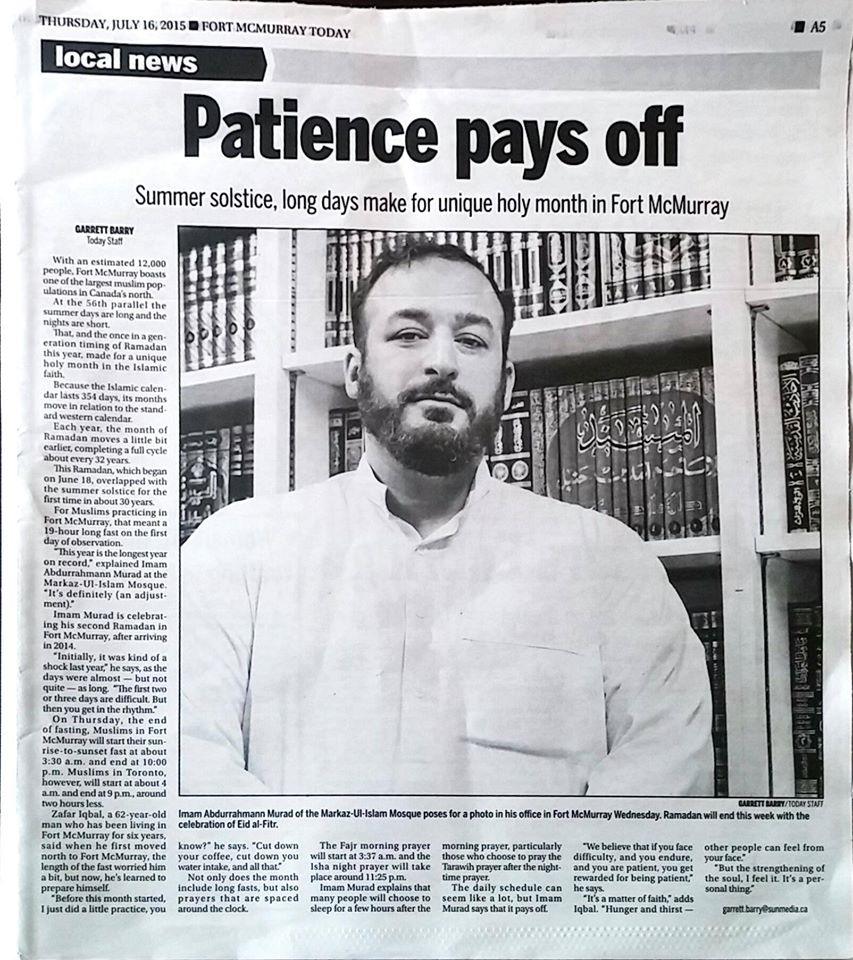

The Five Broad Fiqh Rules
All the praises is for Allah the Lord of the Worlds and peace and blessings be upon His Chosen Messenger Muhammad and upon his family and his companions all of them.
By the Student of Knowledge, Shaykh Abdurrahman Murad هداه الله
These FIVE guidelines are agreed upon among the Ulama of this Ummah.
In this course we will be looking at the importance of these guidelines and how we, the average ‘end-user’, can extract from them life-lessons and gain a better appreciation for the work of the great Imams.
Inshallah, we will post a quick summary of each as we complete them, Inshallah.
Summary of First “Broad” Guideline #1 of 5:
Today, we covered the most important guideline of the 5: الأمور بمقاصدها
Meaning: All actions are considered by their intentions.
This guideline is based on the famous Hadeeth…the Prophet, may Allah praise him, said:
إنما الأعمالُ بالنياتِ، وإنما لكلِّ امرئٍ ما نوى
Meaning: Indeed all actions are considered by their intentions. (Bukhari)
All acts of worship and transactions are subjected to this comprehensive Fiqh Guideline.
It is known that all acts of worship will only be accepted with two conditions…one of which, to do the act sincerely for the sake of Allah (i.e. that one’s intention be that he do the act of worship for the sake of Allah).
A specific example of how intention plays a key role in acts of worship: If a person during a hot summer day washes the parts of wudhu, perfectly, but his intention was to cool himself off and he had no intention of performing wudhu, and then later realizes that the prayer is just around the corner…must he perform the wudhu (although he just washed all that needs to be washed for wudhu)? In this case he MUST make the wudhu as he did not intend to make it the first time around. As you can see intention is key in this act of worship and all others!
In terms of transactions, it plays an equally important role. One example is in terms of divorce. If a person says to his wife ‘go back to your family’…for this statement to be one tantamount to divorce, we look at his intention; if he intended with this statement ‘divorce’ then divorce would take place…but if he meant, go to your family for the sake of a trip…then that would be the case.
We ask Allah to help us purify our intentions for His sake…Ameen!
Summary of “Minor Fiqh Rule” #1 of 5: التابع تابع
Meaning: Secondary matters/things that result from something will take the ruling of what they came from.
Now, this rule is quite straightforward and has countless applications.
But before talking about the applications…lets look at the proofs behind this rule:
a. The Prophet, may Allah praise him, said: “Indeed when Allah forbids something, He forbids the price/profit that is made from it as well.” (Authentic – Ahmed # 4/236)
b. The Prophet, may Allah praise him, said: “When a pregnant animal is slaughtered, what is in the womb would become lawful.”
In these two narrations…what resulted from something took the ruling of its source.
Some of its applications:
a. Allah, the Exalted, says: “…and pig flesh, it is impure…” In this verse Allah, the Exalted, prohibits pig flesh…but what is the ruling of its skin, bones and fat? The above rule clarifies the ruling here! Since the bones, fat and skin are tied with the flesh…they all take the same ruling.
b. If a brother comes to pray in the Masjid, but finds it full and the rows for prayer have gone out of the Masjid to the garden of the Mosque…before this brother sits down…must he perform Tahiyatul-Masjid? The above rule clarifies the ruling here! Since Tahiyatul Masjid should be performed in the Masjid and this area has been annexed to the prayer area of the Mosque building, due to the connected rows extending to this area, one should perform Tahiyatul Masjid.
Summary of Second “Broad” Guideline #2 of 5: Today, we covered: المشقة تجلب التيسير
Meaning: Difficulty brings ease.
There is no doubt that our Shari’ah is built upon a basis of ease (tayseer). The proof of this concept is found throughout the Qur’an and Sunnah.
In Surat ash-Sharh, Allah, the Exalted, says: “Indeed with difficulty there comes ease.”
In the Sunnah, we find that whenever the Prophet, may Allah praise him, was presented with a choice; one more difficult and the other easier, he always chose the easier of the two, unless it was sinful.
Ease no doubt touches on both aspects of worship and transactions.
In relation to worship, while traveling one is allowed to access permits that pertain to prayers and fasting. For example, one may shorten and combine prayers during a long distance travel. They may also break their fast.
In relation to transactions, if one is owed some money…and the time period is up (and the party owing must make payment but cannot) Allah instructs us to “give that person a chance.” When one is giving this chance, they will be no doubt rewarded by Allah.
These are just some of the aspects that tie in with this great rule…we ask Allah to make us among those who live by this concept in life…Ameen
Summary of “Minor Fiqh Rules” #2 to 5: Last week we covered a number of significant Fiqh rules, and how they are applied in practical situations.
a. الأصل في الكلام الحقيقة. All texts/statements are to be taken at face value (i.e. literally) unless there is a definitive proof to indicate that the metaphorical meaning is intended.
When a person speaks they should not ‘double speak’; speak with clear intent, and make euphemisms known where it counts.
b. البينة على المدعي. The burden of evidence is upon the plaintiff. During the Caliphate of Ali, may Allah be pleased with him, an individual stole his armor; the Caliph took that individual to the court and there It was determined that the armor belonged to the individual (who was a thief). So impressed was this thief with this justice system, that he became Muslim!
c. الضرورات تبيح المحظورات. Dire needs (life and death situations) temporarily allow one to access that which is unlawful. This is NOT an open gateway for one to commit the unlawful…but exemplifies that preservation of life is given priority, as this ‘goal’ is one of the aims of Shari’ah. Pressing needs (حاجات) that make one’s life discomforting likewise would temporarily allow one to access the unlawful. This is proven through the Hadeeth of our beloved Prophet, may Allah praise him, where a man whose nose was cut off was allowed to craft for himself a nose from gold (although gold is unlawful for men).
d. لا ينسب إلى ساكت قول. One cannot attribute a statement/position to an individual on account of his/her silence. This judgmental behavior happens all too often in today’s world, especially in the realm of the internet.
Summary of Third “Broad” Guideline #3 of 5: Today, we covered: لا ضرر ولا ضرار
Meaning: Do not harm yourself or others.
This rule is quite self-explanatory, but what is worth mentioning here is that Islam is built upon “5 Directives”…these directives are the preservation of faith, preservation of life, preservation of one’s intellect, preservation of one’s progeny, and preservation of one’s wealth.
To give a clear example of this…if fasting would lead to the detriment of one’s health…one should not fast, as preservation of one’s life takes priority.
This guideline also sheds light on what is Halal. In general, “Halal” is perceived to be what does NOT contain pork or alcohol. This is only part of the answer…as the other aspect is that it not be harmful to your health. If a substance is proven to be harmful to one’s health, then it too becomes unfit for consumption and takes the ruling ‘Haram’ (unlawful).
So in my previous post…fish being fed ‘pig feces’…what is the ruling? We have to first look at the proven or known harms. In various reports it indicates: “In June 2007, the Food and Drug Administration (FDA) detained several farm-raised fish from China, including catfish, basa, dace (a kind of carp), and eel, due to unsafe residues of antimicrobial agents not approved for use in the United States. The antibiotics nitrofuran, malachite green, and gentian violet were shown to cause cancer after long-term exposure, while fluoroquinolones could cause antibiotic resistance.”
This has been reported in many reports! So the harm is pretty much a ‘given’. We seek refuge with Allah!
Now looking at what the scholars have said about this is interesting…let’s look at the Ma’dha’hib have said about eating an animal/fish that the majority (or all its feed) is from filth:
a. Imam Abu Hanifah, may Allah have mercy on him, stated that it is disliked for one to consume this.
b. Imam Malik, may Allah have mercy on him, stated that it is lawful for one to consume, the reason he states is that although it has eaten filth, the filth has gone through a form of chemical process, thus purifying it.
c. Imam Ash-Shafiee, may Allah have mercy on him, stated that it is disliked, but some of the Shafi’ee scholars actually stated it to be outright forbidden, unless the animal in question was purified.
d. Imam Ahmed, may Allah have mercy on him stated that it is outright forbidden, and unlawful for one to consume (unless it is purified).
Strongest View: It is forbidden to consume…this is backed by this Fiqh Rule (do not harm yourself or others). Evidence of continued contamination, the documented method in which the animals/fish are raised, prepared and then shipped (not even given a moment to become pure!) and the scientific danger mentioned in consuming it (salmonella, and e-coli) is clear indication of its harm. The notion of the filth ‘chemically changing’ in the Chinese fish imported into local markets is a non-existent notion as it is not given that chance, but rather immediately farmed from filthy cesspools once reaching prime size.
You can see clearly from this news report and others like it, why filth like this is impure and not fit for consumption…the Prophet, may Allah praise him, forbade the consumption of Jal’laalah (i.e. animals that the majority of its feed is impure) and from drinking its milk.” (Authentic) This prohibition is in line with the preservation of one’s life, one’s intellect and one’s progeny!
Word of advice…EAT LOCAL AND FRESH…GO GREEN (if you can)…GO ORGANIC!
We ask Allah to bless us…Ameen!
Summary of Fourth “Broad” Guideline #4 of 5: Today, we covered: اليقين لا يزول بالشك
Meaning: Certainty is not to be cast aside on account of doubts.
This guideline is very comprehensive. Imam As-Suyooti, may Allah have mercy on him, mentioned that it has an application in 3/4 of Fiqh.
There are many Hadeeth that indicate this guideline; one of which is the words of the Prophet, may Allah praise him:
إذا شَكَّ أحدُكُم في صلاتِهِ فلم يَدرِ كَم صلَّى ؟ ثلاثًا أمْ أربعًا ؟ فليطرَحِ الشَّكَّ وليبنِ على ما استيقنَ
Meaning: “If one of you doubts in his prayer and is unsure as to how many Rakah (units) he has performed, three or four, let him cast aside the doubt and build upon that which is certain.” (Muslim #571)
The examples for this rule are countless. I’ll end this summary by saying that the Prophet, may Allah praise him, mentioned to us the reward of upholding this guideline. He, may Allah praise him, said:
ثمَّ يسجُدُ سجدتينِ قبلَ أن يسلِّمَ . فإن كانَ صلَّى خَمسًا ، شفَعنَ لَه صلاتَه . وإن كانَ صلَّى إتمامًا لأربعٍ ، كانتَا تَرغيمًا للشَّيطانِ
Meaning: (this is a continuation of the previous narration in Sahih Muslim) “after this, he should then prostrate two sujood before the Tasleem. If he has performed five Rakah, it would not harm his prayer. If he then completes the prayer as four units, it would serve as a humiliation to shaytan.”
We ask Allah to grant us success in this life and in the next. Ameen!
Summary of Fifth “Broad” Guideline #5 of 5: Today, we also covered: العادة محكمة
Meaning: Societal norms and customs can be considered in Shari’ah rulings.
This is a very important rule, and on numerous occasions is actually misquoted and taken out of context.
To sum this rule up, we have to understand when the “Urf’ or “Aadah” (societal norms / customs) can be considered. The scholars mentioned:
a. A custom being considered must not break the rules of the Qur’an and Sunnah.
b. A custom being considered must be widely practiced.
c. When a custom is being considered, it must be in practice and not one that has been long forgotten or its use discontinued.
So in essence, what we hear about ‘women’s rights’ from a cultural perspective, in certain countries, cannot be considered in Shari’ah, as the vast majority of these behaviors usually contradict with what is found in the Qur’an and Sunnah.
Let’s forget about the ‘canned’ examples that we so often hear about…this ‘broken’ Urf (custom) is even present here in the West. Dr. Arthur E. Hertzler from Kansas/USA said: “The only way to keep a woman happy is to keep her barefoot and pregnant (in the kitchen).”
By the way, ‘barefoot’ indicates that a woman should never be allowed independence…never given financial freedom and subjugated in some way or the other.
This Aadah is rejected as we stated above no matter where it comes from!
An example of this rule: If a transaction has been conducted by an individual in Canada and the medium used and recognized is the Canadian dollar, but later when the seller receives payment states, I meant ‘American Dollars not Canadian Dollars’, the Aadah (societal norm) is referred to in this case. Since the two are living in Canada and all similar transactions have been conducted with Canadian dollars, the Aadah would dictate that this sale would be in Canadian dollars. Here the Aadah is used and is effective to determine this point.
We ask Allah to protect us from ignorance. Ameen!





 Works of Abul Baraa Muhamad Amreeki
Leave a reply to Islam’s Finest Blog Owner Cancel reply