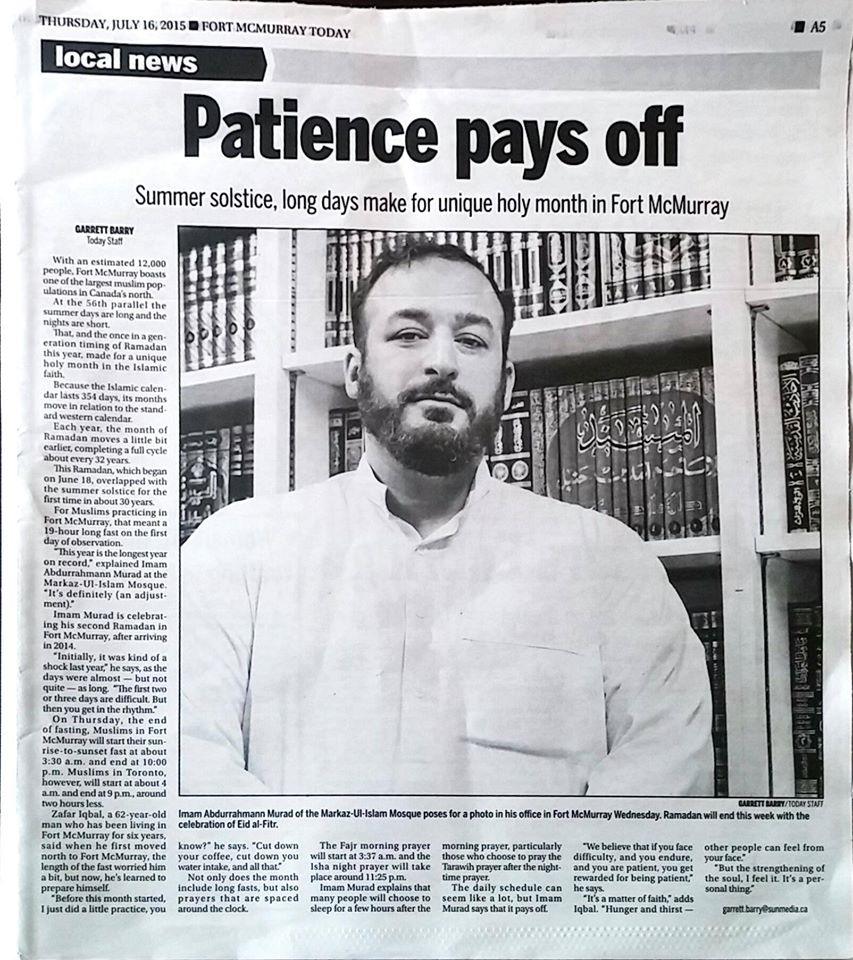

Local news report from Fort MC MCMurray News Paper.
With an estimated 12,000 people, Fort McMurray boasts one of the largest Muslim populations in Canada’s north.
At the 56th parallel the summer days are long and the nights are short. That, and the once in a generation timing of Ramadan this year, made for a unique holy month in the Islamic faith.
Because the Islamic calendar lasts 354 days, its months move in relation to the standard western calendar. Each year, the month of Ramadan moves a little bit earlier, completing a full cycle about every 32 years.
This Ramadan, which began on June 18, overlapped with the summer solstice for the first time in about 30 years. For Muslims practicing in Fort McMurray, that meant a 19-hour long fast on the first day of observation.
“This year is the longest year on record,” explained Imam Abdurrahmann Murad at the Markaz-Ul-Islam Mosque. “It’s definitely (an adjustment).”
Imam Murad is celebrating his second Ramadan in Fort McMurray, after arriving in 2014.
“Initially, it was kind of a shock last year,” he says, as the days were almost — but not quite — as long. “The first two or three days are difficult. But then you get in the rhythm.”
On Thursday, the end of fasting, Muslims in Fort McMurray will start their sunrise-to-sunset fast at about 3:30 a.m. and end at 10:00 p.m. Muslims in Toronto, however, will start at about 4 a.m. and end at 9 p.m., around two hours less.
Zafar Iqbal, a 62-year-old man who has been living in Fort McMurray for six years, said when he first moved north to Fort McMurray, the length of the fast worried him a bit, but now, he’s learned to prepare himself.
“Before this month started, I just did a little practice, you know?” he says. “Cut down your coffee, cut down you water intake, and all that.”
Not only does the month include long fasts, but also prayers that are spaced around the clock. The Fajr morning prayer will start at 3:37 a.m. and the Isha night prayer will take place around 11:25 p.m.
Imam Murad explains that many people will choose to sleep for a few hours after the morning prayer, particularly those who choose to pray the Tarawih prayer after the night-time prayer.
The daily schedule can seem like a lot, but Imam Murad says that it pays off.
“We believe that if you face difficulty, and you endure, and you are patient, you get rewarded for being patient,” he says.
“It’s a matter of faith,” adds Iqbal. “Hunger and thirst – other people can feel from your face.”
“But the strengthening of the soul, I feel it. It’s a personal thing.”
garrett.barry@sunmedia.ca


 Works of Abul Baraa Muhamad Amreeki
Leave a comment