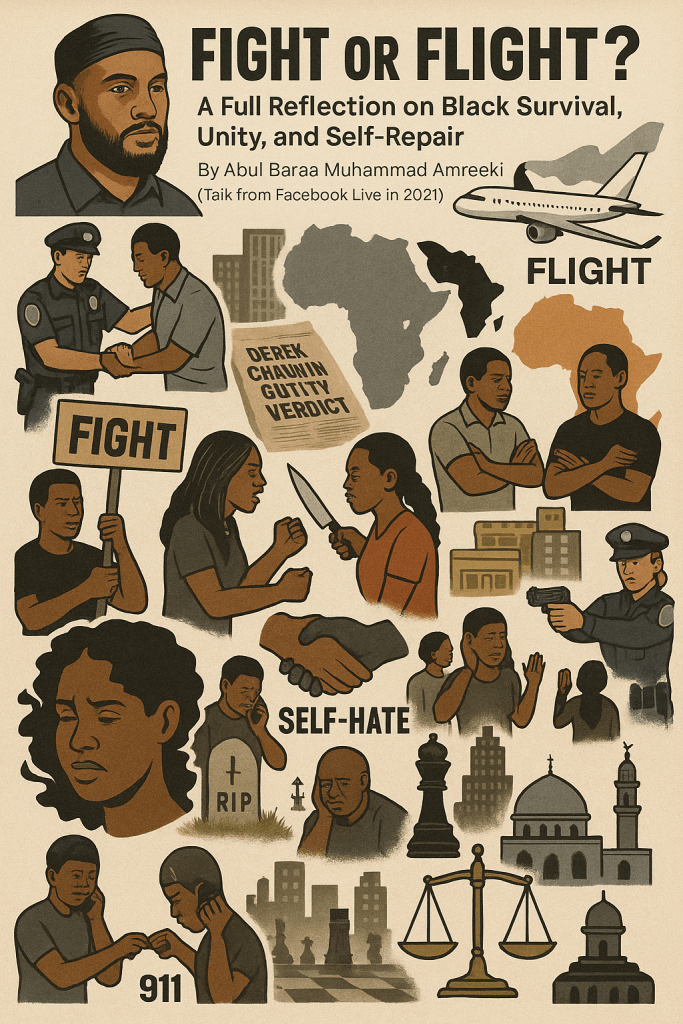
Fight or Flight?
A Full Reflection on Black Survival, Unity, and Self-Repair
By Abul Baraa Muhammad Amreeki (Talk from Facebook Live in 2021)
Introduction: The Big Question
I’m a foreigner on Facebook, and I want to make a little video—a short talk—about a big question I hear African-American Muslims and the wider Black conscious community discussing: systemic racism in the U.S.—should Black people fight or take flight? In other words, should Black people in America keep fighting the system here, or should they take flight—leave and go to another country?
Why the Question is Urgent
It’s a strong topic because of the high rate of police brutality against Black people, the systemic racism in the legal system, and U.S. laws that, in practice, keep working against us. When you see police kill Black people, harass Black people, and when the legal system does nothing real about it, you realize: the system is working as designed. Despite decades of struggle for civil rights and civil liberties—despite the end of Jim Crow, the end of official segregation, and policies that came out of the civil-rights movement like affirmative action—we still find Black people back at square one. The same old oppression continues: systemic racism from whites, killings, redlining, and ongoing discrimination. So again the question: Do Black people fight, or do they take flight?
Defining “Fight” and “Flight”
Do we fight the system that oppresses us? Or do we migrate—to another Western country, to Africa, or to some other nation that’s more open to Black people—some place where at least we wouldn’t face the same kind of systemic racism, killings, and mass incarceration? I have my own opinion, but first I want to lay out the options exactly the way people raise them. If we fight: does that mean challenging the legal system, taking up arms, or both? If we flee: does that mean we accept that there is no win for Black people in America and leave for somewhere we think will treat us better?
The Root Issue: Self-Hate
My opinion is broad and detailed: no matter what you do—fight, flee, or both—none of it will solve the problem if Black people still carry self-hate. If we don’t fix the internal mindset, the same damage follows us. If you say, “We’ll fight”—whether that’s through the courts or with arms—look at our track record. When it comes to fighting systemic white supremacy, we don’t have wins because we’re still fighting and killing each other. I’ll come back to what I mean by that in a moment. If you say, “We’ll flee”—move to a place with fewer problems for Black people—there’s a problem there too, and it goes back to the mindset. If we don’t fix self-hate, no matter where we go, we carry the same problems.
Flight Options: Europe, Asia, Africa
Example: move to the U.K. or Europe. Europe is the origin of modern white supremacy. If you go to another Western European country, you’ll still face racism, prejudice, and aggression from whites. Example: move to parts of Asia. You will encounter anti-Black attitudes. Maybe you won’t fear police shootings, but you and your children will still face racial bias. Citizenship reality: when you migrate, you’re not a citizen; you’re a resident or on a visa. Your rights are limited. Example: go to Africa. That can be a great path for Black entrepreneurs from America. But if you go expecting instant “Black unity,” you may be surprised. Many African societies have deep tribal dynamics and, in some places, even more intense intra-Black divisions than in the U.S. Depending on where you go, some communities may not accept you at first; some are friendly, others not. If you still carry self-hate and you haven’t dealt with the real roots of our internal problems, simply moving won’t remove them. Add to that the infrastructure differences: some nations are not Western-style first-world countries. You may lose certain luxuries you’re used to, face systems you don’t like, and have little power to change them because you’re not a citizen. Laws can change on you. You can be removed. If your mindset isn’t ready for hardship, you’ll end up right back in the U.S.
Contradiction in Fighting Each Other
Back to the “fight here” option: some say if police kill a Black person, we should take up arms in response—take revenge to deter future killings. Maybe that seems like a solution. But what happens when Black people are killing Black people? What do we do then? This is the real issue: we hate law enforcement killing Black people, but within our own circles, Black people kill Black people at a high rate. Who will be ready to fight the system if we’re busy fighting each other? Look at white supremacy’s militias: they stick together. They’re not killing each other; they are preparing to fight you. Meanwhile, we’re not ready to fight the system because we fight each other daily. We even call the white police on each other. We fight each other so much that when conflict hits, we are the ones who dial 911 on one another.
Collapse of Male Leadership
Consider a recent police shooting of a Black teenage girl (15–16 years old) that happened around the time of the George Floyd demonstrations. When you strip away media spin and look at the body-cam and the 911 call, you notice something missing: no Black men—no adult men—stepping in. I heard an emotional Black woman on the phone, but I didn’t hear or see Black men present to stop the escalation. And again, a Black person called the police—the same police known to kill Black people—on another Black person who was a kid. When police arrive, no adult Black men step forward to de-escalate. That is part of our problem. Morally, we are lost. Without moral structure and with a lot of self-hate, we won’t be victorious anywhere. We can’t fight “the white man” when we are busy fighting each other and when our internal moral structure is weak.
The Reality of White Power
In that case, I was upset watching the video. The officer could have used mace or a Taser—not four shots. But again, from the 911 call to the arrival, there were no adult Black men stopping the nonsense. We have homes with no stable male leadership—or only weak “beta” presence—and we allow youth to spiral. Then, when blood spills, we call the “white race soldiers.” And when they arrive, they often show no mercy. They see us as “savages” and act accordingly. He’ll say, “You act like an animal; I’ll treat you like one.” That’s the thinking we’re up against. You’ll even see police treat a stray dog with more mercy—calling animal services, sedating or tasering—not killing. But a Black person in conflict is too often killed. In the eyes of white power, the dog is “man’s best friend”—ranked higher than the Black person. That’s the reality we keep colliding with.
Fight, Flight, or Division?
So how do we talk about fighting a system when we hate each other, hate our skin, won’t trade with each other, and won’t spend money with each other? How do we fight the system if we’re hollowed out by self-hate? Some say the answer is fight or flight. In psychology, under trauma, the body prepares to fight or flee. That’s natural. Today we have two camps: one wants to fight, one wants to leave. We can’t even agree on a plan. That alone shows we lack unity. We can’t even sit down, weigh the two options, and reach one decision for the collective. And even if we flee, fleeing doesn’t solve systemic racism. Where are you going to go where white supremacy doesn’t rule?
Global White Supremacy
Europe or Africa? European and Russian powers own influence over Africa. Many African leaders were educated in the West. The West shapes African politics and extracts resources. Where will you go to flee white supremacy? Snowden example: when Edward Snowden exposed U.S. surveillance, he didn’t go to Africa or the Arab world; he went to Russia—because he knew that’s where U.S. power had the least leverage to reach him. Ask yourself: which African, Asian, or “friendly” European countries truly stand outside Western power? Very few. So if we “leave America to escape systemic racism,” where exactly are we going that isn’t touched by the same power structures?
The Real Solution: Mental and Moral Transformation
If you’re leaving because you don’t want to deal with systemic racism anymore, but you don’t fix our internal issues, you’ll face problems anywhere. You won’t be a full citizen; you won’t have full rights; you’ll feel that. If you go to Africa, you’ll still face self-hate dynamics, because our self-hate has roots that go back centuries. How did we end up enslaved in America? Africans sold other Africans to Arabs and Europeans. That’s part of the history. Africa itself is a continent that should have been able to act as one, but instead it’s divided into many nations—divided peoples are easier to conquer and exploit. European control of resources persists because Africans are divided by self-hate and factionalism. So going to Africa without addressing self-hate means you’ll still face no unity. That’s why I say: the Black revolution is an evolution—a mental and moral transformation. We must remove self-hate. If we remove it, we gain unity because we share one objective: self-preservation and flourishing.
What Other Groups Do
Look at other groups: Asians in America often don’t have this level of self-hate; they often show strong internal networks. White people don’t have this level of self-hate for each other. Consider Joe Biden. When he took office, he said to Trump supporters—many of whom aligned with white supremacist politics—“I am your president.” He signaled: even if you didn’t vote for me, I still claim you. That’s intra-white cohesion. You may disagree with policies, but observe the pattern: white people support white people, even when they’re wrong. Meanwhile, Black people will divide over the smallest things, even kill each other over the dumbest things.
Admission and Therapy
We have to heal. Think of AA meetings: the first step is admitting you have a problem. Therapy only works if you want it. If Black people won’t admit our self-hate, we can’t get therapy and we can’t get unity. We’ll keep losing.
Economic Trap in Our Neighborhoods
Walk into Black neighborhoods where I’m from in New York: Arabs own the liquor stores selling poison in our communities, and Black people tolerate it. Then we complain: “Why do immigrants own businesses in our neighborhoods while we own nothing?” Yet we keep patronizing them anyway. That’s self-hate. We accept exploitation from non-Black owners but want to fight a Black owner who wrongs us. Why aren’t we running out those who exploit us? Why only rage at our own?
Moral Structure & Islam’s Appeal (Crusades Lesson)
Our moral structure is weak. One thing that drew me to Islam when I was young was reading global history in school: despite the American education system glorifying Europe, I learned about the Crusades, how Muslims—Arabs and Persians—fought off European crusaders (even if centuries later Europeans returned to dominate). The point is: when confronted by a foreign invader, Muslims united and held the line. That showed me a religion that could organize people for collective defense. Black people in America lack formal training by our own people for our own people. We get a white supremacist education that teaches white power as the default. Even when we learn about slavery, we are actually being taught economics: free labor built wealth. White supremacy is about economics and power, and systemic racism must remain in place to maintain that power.
Power Won’t Share Itself
So of course they won’t share power. Imagine you work 40 hours a week and a stranger demands your entire paycheck—would you give it up? That’s how the white power structure hears Black demands for equal share within their system. They won’t say this out loud; they’re strategic. They’ll virtue signal instead.
Derek Chauvin Verdict: Pawn, Not Structure
Derek Chauvin’s guilty verdict is a good example. Look at the trial: the prosecution had multiple lawyers and expert witnesses from all over. Chauvin had one lawyer. Who paid for that state team and those resources? The government. Why? Because the state would rather hand you a verdict that calms the streets than give you true structural change—laws, policies, or economic power that shift the system. A single guilty verdict didn’t change policing statutes, union contracts, or qualified immunity. It didn’t restructure budgets. In chess, the pawn is expendable; the king and queen are what win or lose the game. The system sacrifices a pawn officer, hires another to replace him, and carries on.
Company Analogy: Why Power Isn’t Shared
Back to the company analogy: if you built a million-dollar company and someone who didn’t do the work demanded to be CEO, you’d say, “Get out.” White America thinks, “We built this system—intellectually, structurally, and economically.” They believe they won’t hand over control to people they see as divided and self-hating. Even a non-racist white person might say, “If you’re always fighting each other, you’ll crash the whole ship if we put you at the helm.” That’s how they justify keeping power.
Why Islam Is Needed
This is why, in my view, Black people need Islam (my opinion): discipline, law, moral structure. The church (as it functions in the U.S.) is often about commercial religion—tithes and performance—not the kind of disciplined social order needed to build power. Think about any workplace: if your team is constantly fighting each other, there’s chaos, no control. Why would the white power structure share power with a group that can’t maintain internal order?
Token Sharing With Others?
Some say maybe power will be shared with Asians or certain Latinos one day because they often show unity and less internal conflict. But white supremacy is not built to share; that’s not its design. Even if some sharing happens at the margins, the core remains.
Before Fight or Flight: Heal Self-Hate
So before fight or flight, we must remove self-hate and learn to live with each other as Black people. If we don’t focus on that, we’ll have no success anywhere—stay or go—because the root problem will return: self-hate leading to no unity.
Current Headlines & Self-Governance Crisis
Let me add current headlines. I watch the news: a Black woman killed her two newborns—likely mental-health related, but it shows how deep the crisis runs. In the Bronx and Brooklyn, Black people shooting each other. We shouted “defund the police,” and now many of the same folks are begging for more police because we can’t govern ourselves. That’s what happens when moral structure collapses.
Final Bottom Line
We need to focus on healing self-hate and building moral structure. Without moral structure, there is no unity. Without removing self-hate, there will never be unity. So here’s my bottom line:
Fight without unity becomes self-destruction.
Flight without healing becomes exported dysfunction.
Unity requires moral structure, elders, fathers and mothers present, economic intention, and a shared code that stops us from calling the police on each other when we could de-escalate ourselves.
The Black revolution is an evolution: a mental, moral, and spiritual transformation that removes self-hate so unity becomes natural. Then, whether we fight or flee, we can actually win.
Closing
I didn’t mean to make this long, but it’s been on my mind. People keep saying, “Fight or flight.” I’m saying: first fix the root—self-hate and the collapse of moral structure. Without that, neither fighting nor fleeing will save us. With that healed, either path can work. Food for thought.



 Works of Abul Baraa Muhamad Amreeki
Leave a comment