By Abul Baraa Muhammad Amreeki
Introduction
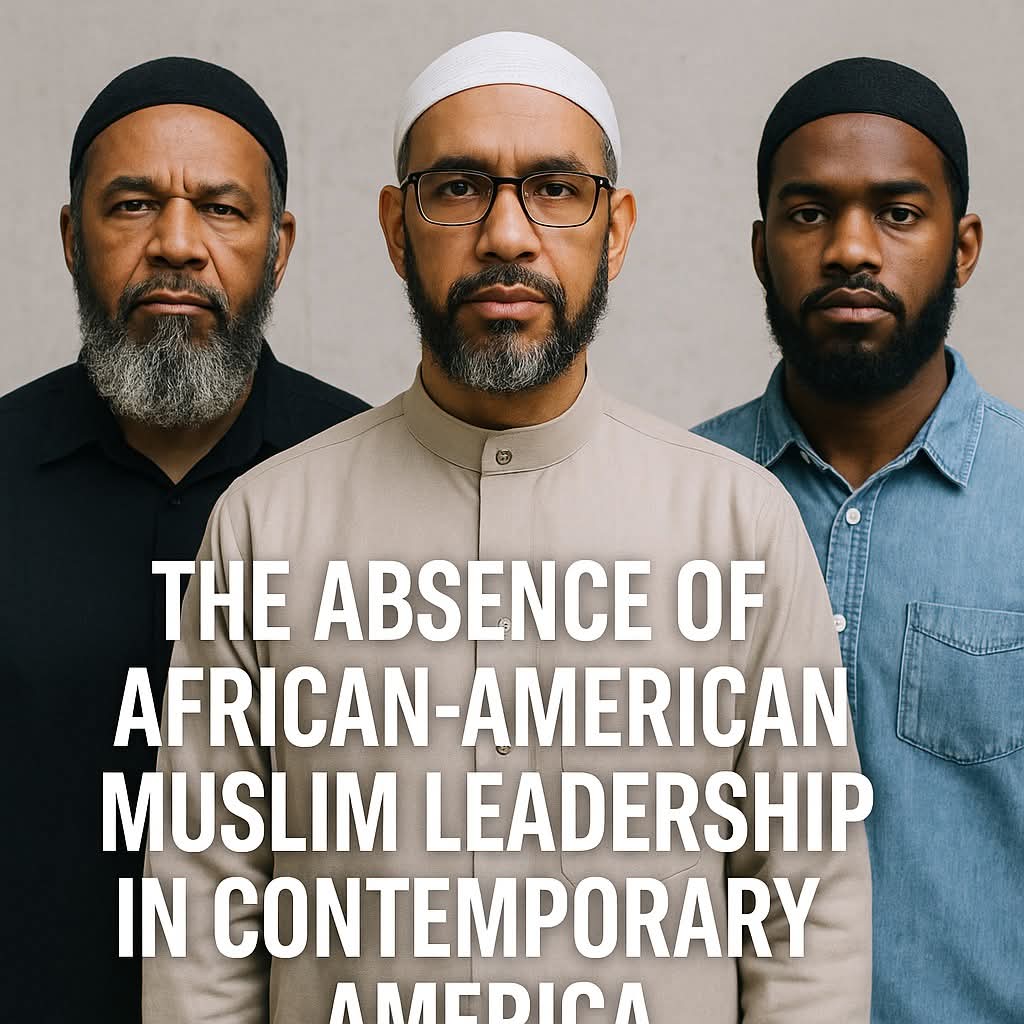
The question of leadership in the African-American Muslim community is both pressing and underexplored. Historically, African-American Muslims played visible and influential roles not only within Muslim spaces but also in broader struggles for justice, particularly during the civil rights era. Figures such as Malcolm X and Imam Warith Deen Muhammad, though differing in theology and methodology, were widely recognized as leaders who shaped the discourse of their time. Today, however, a troubling absence of comparable figures is evident. While the African-American Muslim community has produced many individuals with advanced religious education and access to global Islamic scholarship, their presence in activism and community leadership appears significantly diminished.
This paper seeks to address the following questions:
- Why are there no Muslim leaders in the Black community today who mirror the impact of those in the past?
- What restrictions, internal and external, prevent African-American Muslim leaders from being active voices for their people?
- How has the model of leadership shifted from grassroots activism to an inward, masjid-centered approach that lacks broader social engagement?
Historical Context of Black Muslim Leadership
In the mid-20th century, African-American Muslim figures emerged as powerful voices for justice. Malcolm X, despite not having advanced Islamic credentials, became one of the most influential leaders of his generation. His articulation of Black dignity, independence, and resistance to oppression resonated with Muslims and non-Muslims alike, across racial and national boundaries.
Similarly, Warith Deen Muhammad transitioned many former members of the Nation of Islam into Sunni Islam, providing an alternative spiritual and social vision. Despite disagreements about his theological positions, he remained a recognized leader whose name was familiar even to non-Muslim African-Americans. This generational memory is evidenced by elders — such as those who recall his speeches from the 1960s and 1970s — testifying to his impact on Black America.
These leaders, though differing in knowledge and methodology, were united by one essential characteristic: they were not confined to the masjid. Their work connected directly with the struggles of Black people in the streets, in prisons, and in the broader society.
Divergent Paradigms: Malcolm X and Martin Luther King Jr.
A vital part of this discussion is the clear difference between the approaches of Malcolm X and Martin Luther King Jr.
Malcolm X rejected Martin Luther King Jr.’s vision of integration. He argued that inclusion without independence would keep Black people weak and dependent. Malcolm believed that Black communities must build their own institutions, develop their own wealth, and claim their own dignity, rather than simply seeking a place at the table of the existing system.
In contrast, Dr. King envisioned interracial unity and integration into existing structures, but Malcolm saw that as a trap if it lacked power, ownership, and self-determination.
This is not just a matter of history. It is a lesson for today. As Dr. Claude Anderson (a Christian scholar of Black economics) explained, Martin Luther King Jr.’s vision of inclusion could not resolve the deeper issue: the lack of economic infrastructure for Black people. Dr. Anderson openly stated that he found Malcolm X’s approach more compelling, because Malcolm X insisted on independence and power.
Implication for Muslims: This contrast is central for African-American Muslims. Today’s Muslim leaders have immense religious knowledge but often follow a model closer to King’s integrationist approach — seeking acceptance within the broader framework but lacking real independence, grassroots action, and institutional power. The Malcolm model, on the other hand, requires public presence, economic development, and fighting alongside the oppressed in tangible ways.
The Contemporary Condition of African-American Muslim Leadership
In contrast, the present African-American Muslim landscape is characterized by a proliferation of educated students of knowledge. Many have studied at Islamic universities in Saudi Arabia, Egypt, Yemen, and other parts of the Muslim world, returning with advanced degrees in Islamic sciences. Their knowledge often surpasses that of past leaders in terms of formal training and religious sciences.
Yet, paradoxically, this increase in knowledge has not translated into increased activism. These leaders are largely confined to masjids and Islamic centers. Their da’wah is limited to lectures, classes, and social media platforms. While beneficial in religious education, such methods fail to engage with the pressing realities of Black communities in America.
This disconnection has created a leadership vacuum. Despite having shaykhs and students of knowledge, African-American Muslims lack public figures who can influence political, social, and cultural realities in the same way earlier leaders did. The activism of today’s scholars is limited in scope, often reduced to offering shahadahs, running da’wah tables, distributing food donations, or producing online lectures.
Restrictive Models of Leadership
One reason for this decline in visible leadership lies in the adoption of foreign models of religious authority. In the Muslim world, shaykhs often function within controlled religious institutions. They are rarely activists, and many deliberately avoid involvement in political or social struggles. Their primary roles involve teaching, issuing fatwas, and supporting the religious framework sanctioned by the state.
When African-American Muslims adopt this model, they unintentionally restrict their leadership to the masjid. They imitate the structure of Arab religious institutions without recognizing that such structures are tied to very different historical and political realities. In America, where systemic racism, police brutality, and poverty affect millions of Black people, such a model proves insufficient.
The absence of activism among African-American Muslims, therefore, is not merely personal but structural. It reflects a misplaced attempt to transplant a foreign religious culture into a context where leadership requires public engagement, advocacy, and visible defense of the oppressed.
Consequences of Inward-Focused Leadership
This retreat into the masjid has serious consequences. When crises strike — such as the COVID-19 pandemic, the closure of masjids, or the protests following the murder of George Floyd — many African-American Muslim leaders were absent from the public square. With their platforms tied solely to masjid life, their voices fell silent when masjids closed.
Meanwhile, the realities of the streets continued to affect Black Muslims and non-Muslims alike: police brutality, systemic inequality, mass incarceration, and poverty. Communities that once looked to religious leaders for guidance found them largely absent. Without leaders willing to address these urgent realities, Islamic teaching risks becoming disconnected from the lived experiences of the people.
The Example of Historical Islamic Expansion
History provides lessons that highlight the importance of connecting with oppressed peoples. When Islam entered Egypt and North Africa, the Sahaba and Tabi‘un allied themselves with the oppressed communities under Byzantine rule. Their solidarity with marginalized groups facilitated both the spread of Islam and the downfall of oppressive systems.
Likewise, when Muslims entered Spain from North Africa, they connected with oppressed Christians and Jews, winning allies and establishing influence. The success of Islam in these regions was tied directly to Muslim engagement with the struggles of ordinary people.
By contrast, contemporary African-American Muslim leadership often fails to embody this prophetic and historical model. Rather than allying with the oppressed, many restrict their da’wah to insular Muslim spaces, disconnected from the struggles of the people they should serve.
The Challenge of Identity and Assimilation
Another dimension of the problem lies in identity. Many African-American Muslims unconsciously distance themselves from their Black identity, adopting attitudes from Arab cultures that carry dismissive or even racist views toward Black people. In doing so, they alienate themselves from the very communities they should be leading.
This creates a contradiction: while Islam is growing in America, especially among Black people, the leadership remains detached from Black realities. Converts who enter Islam may quickly find themselves in masjids that do not recognize or address their lived struggles. Over time, this disconnect risks disillusionment, stagnation, and even departure from Islam altogether.
The Question of Social Responsibility
The central question remains: Where are the African-American Muslim leaders who will address poverty, crime, systemic racism, and political marginalization? Where are those who will stand in the streets alongside the people, as Malcolm X once did, without fear of imprisonment or death?
Relying on immigrant organizations such as ISNA, ICNA, or Yaqeen Institute is insufficient. These institutions were not founded to address the unique struggles of Black America. Their missions, often rooted in immigrant concerns and economic integration, do not prioritize the liberation or empowerment of African-American communities.
Therefore, the responsibility falls upon African-American Muslims themselves. Leadership must emerge from within, rooted in both Islamic knowledge and grassroots activism.
Conclusion: Toward a Model of Action-Oriented Leadership
The African-American Muslim community today faces a crisis of leadership. On one hand, it possesses an unprecedented number of educated scholars and students of knowledge. On the other, it suffers from a lack of activists who can connect with the struggles of ordinary Black people.
If leadership remains confined to masjids and social media platforms, it will fail to address the pressing realities of the community. Knowledge without action becomes stagnant. Preaching without engagement loses its relevance.
History demonstrates that Islam spread and flourished when Muslims aligned with the oppressed and acted as agents of justice. The African-American Muslim community must rediscover this model of leadership. Without it, the disconnection between religious teaching and social reality will only widen, leaving future generations without the guidance and representation they desperately need.
Side Note:
For those who have an issue with me addressing Black social issues in the Muslim community, for those who blur the line between truth and anti-Blackness within the Muslim community, and for those Black African American Muslims who are full of self-hate and refuse to address Black social issues, and those Black African American Muslims who fear the System and remain slient — listen to the words of our Prophet ﷺ about his Prophethood and his lineage.
At the Battle of Ḥunayn, when many of the Muslims fled in fear, the Prophet ﷺ stood firm and declared:
أنا النبي لا كذب، أنا ابن عبد المطلب
“I am the Prophet, no lie! I am the son of ‘Abdul-Muṭṭalib.”
(Saḥīḥ al-Bukhārī 4317, Muslim 1775)
He reminded them of his divine mission and his lineage. He stood tall in a moment of weakness for the community, claiming his identity with courage and certainty.
As Black American Muslims, we must learn from this. Our history in this land has been scarred by slavery, racism, and systemic oppression. Too often, we are told to silence our issues in the name of “unity” — but in reality, that silence often serves anti-Blackness. Some of us even internalize that poison, turning away from our own people’s struggles.
But the Sunnah is to stand firm in your identity. The Prophet ﷺ was not ashamed to declare who he was and where he came from. Neither should we be ashamed of being both Black and Muslim. Our lineage may not be Abdul-Muṭṭalib, but it includes Bilāl ibn Rabāḥ (رضي الله عنه), the trusted companion, the first mu’adhdhin, and a Black man honored by the Prophet ﷺ himself.
So when racism, fear, or self-hate tries to make us shrink, remember the example at Ḥunayn: Stand tall. Declare who you are. Know that Allah has honored you with Islam — and never let anyone shame you out of addressing the truth.



 Works of Abul Baraa Muhamad Amreeki
Leave a comment