
Cult Playbook: How Salafi Publications Stage “Refutations”
- Recycle the Same Target
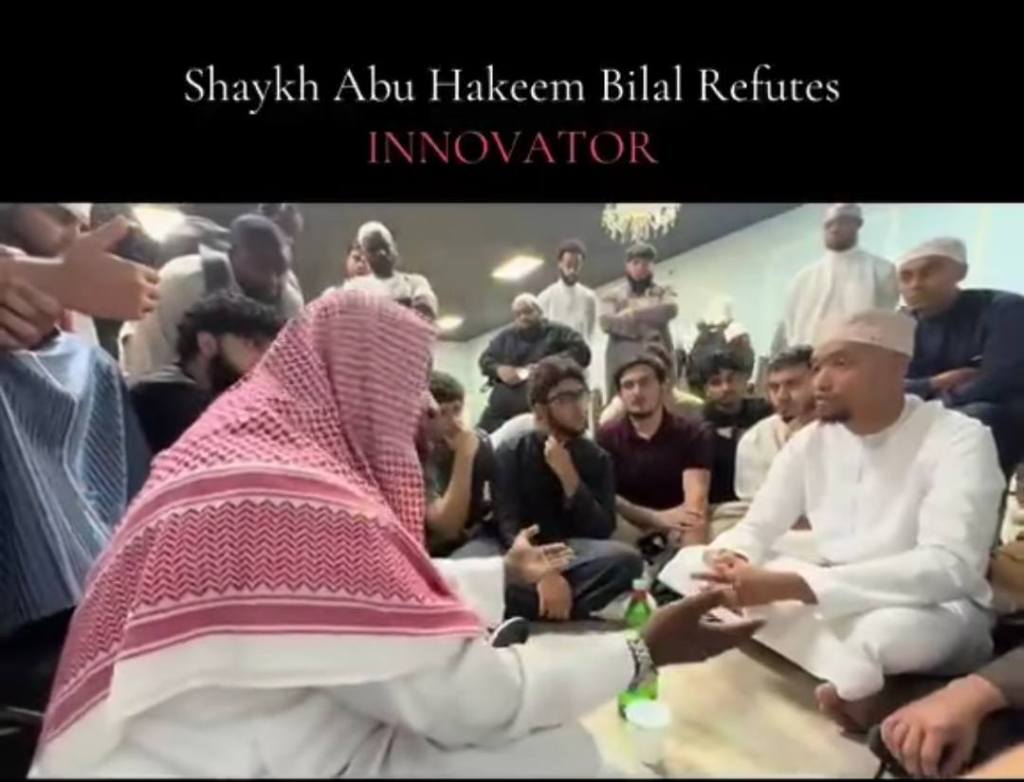
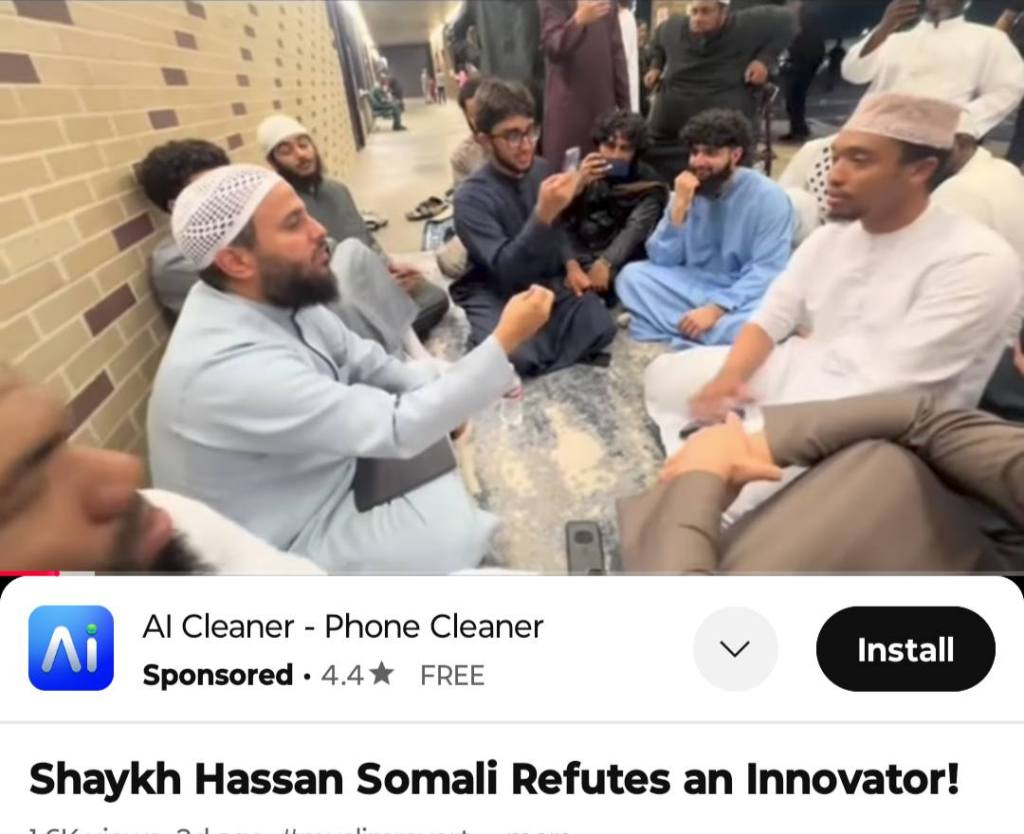
– The same brother is brought forward again and again, this time with Hassan Somali, then with Abu Hakeem Bilal.
– This creates the illusion of a major intellectual battle, when in reality it’s the same easy target being paraded for show. - Choose the Weakest Opponent
– The person clearly struggles to respond—he may even have a learning disability.
– That’s intentional. Cult leaders don’t debate equals; they choose someone who can’t push back effectively. - Turn Debate Into Theater
– Notice the phones recording.
– Notice the crowd gathered like an audience.
– It’s less about truth and more about putting on a performance for social media clips. - Label Him an “Innovator”
– Once someone is given that label, followers don’t even need to think.
– “Innovator” becomes the scarlet letter, shutting down critical thought and making the audience cheer for the “refutation.” - Manufacture Fear and Pride
– Followers see the refuted man and think: “I don’t want to end up like him.”
– At the same time, they feel proud: “Our shaykhs are protecting the truth!”
– This fear-pride loop keeps people loyal to the group. - Content Over Substance
– The real goal isn’t correcting the man—it’s creating shareable clips.
– These videos go out across their pages, feeding the algorithm and reinforcing group identity. - Repeat Until It Feels Real
– Even if the “refutation” is shallow, repeating the same show convinces followers that something meaningful is happening.
– That’s how cult propaganda works: perform, record, repeat.
One thing Salafi publication followers don’t have critical thinking skills, knowledge, Arabic language, and connection to real scholars due to the lack of real sincerity.
The Psychology Behind Cult Tactics in the Salafi Pubs Movement
Introduction
Today, I want to address a serious issue that has been circulating in Germantown Masjid and its affiliated communities—lists of “who to take knowledge from and who not to take from.” This practice is widely promoted by Salafi Publications (SP) and their satellite communities. I call this talk The Psychology Behind Cult Tactics in Salafi Pubs.
This is not just a disagreement about fiqh or aqeedah. It is about a cult-like structure designed to control information, limit critical thinking, and lock followers into blind loyalty to personalities rather than to Islamic knowledge.
Cult Tactic #1: Controlling Access to Knowledge
Cults always control information.
- The leaders decide whose voices are valid and whose must be silenced.
- Lists of “who to take from” create intellectual isolation: followers can only access the group’s approved teachers.
- Anyone outside their circle is branded as misguided, even if that person is a recognized scholar.
This tactic ensures that followers remain dependent on their leaders. It’s psychological conditioning: If knowledge doesn’t come from us, it’s false.
Cult Tactic #2: Personality over Knowledge
In Germantown, Newark, Camden, Philadelphia, and SP’s other communities, the majority of followers are not students of knowledge. They are not mastering Arabic, not studying the sciences of Islam, not connected to real scholars (`ulama).
Instead, they attach themselves to personalities—local figures like Anwar Wright, Hasan Somali, and others. These personalities become the gatekeepers of information, even though they themselves are not scholars by the standards of the major `ulama.
This creates a cycle:
- Followers don’t study Arabic or Islamic sciences.
- They rely on translations and filtered teachings.
- They end up blind-following men who themselves are not scholars.
This is not the minhaj of the Salaf. It is the psychology of cult control.
Cult Tactic #3: False Legitimacy through Lists
SP circulates “lists” of safe and unsafe teachers.
- Real scholars like Shaykh Salih al-Fawzan, Shaykh al-Albani, or others may be referenced—but selectively.
- Scholars who criticized SP or exposed their corruption are deliberately excluded.
This selective citation gives an illusion of legitimacy while hiding the reality: SP’s leaders do not want their followers exposed to any teacher who could break their control.
The Problem with Their Followers
- Ignorance: Most cannot read Qur’an properly, don’t know Arabic, and have no grounding in fiqh or usool.
- Blind following: Instead of building knowledge, they parrot SP leaders.
- Contradictions: They claim to preserve salafiyyah, but their actions contradict it—crime around their masjids, dysfunction in families, and scandals among leadership.
The Prophet ﷺ said: Whoever Allah wants good for, He gives him understanding of the religion.
After decades of Germantown’s existence, where are their scholars? Where are their graduates of Islamic universities? Where are their huffaz of Qur’an? The reality is, they haven’t produced them—because their focus has been control, not knowledge.
Signs of Corruption and Exposure
Allah exposes the corrupt:
- Leaders recorded in bars and restaurants where alcohol is served.
- Leaders caught in scandals involving crime, abuse, or negligence.
- Followers posting shameless content online while claiming “salafi.”
These are not signs of a healthy community. These are proofs that their claim to salafiyyah is hollow.
Why People Follow Cults
Psychology explains it clearly:
- Many people with low self-esteem join cults to feel part of something bigger.
- They fear being cast out, so they suppress doubts and conform outwardly.
- The cult feeds them a sense of superiority: “We are the real Salafis; everyone else is off the manhaj.”
- In reality, they are trapped in groupthink and cut off from real scholarship.
Conclusion: A Call to Accountability
The Qur’an tells us: Allah does not change the condition of a people until they change what is within themselves.
Until Germantown and SP communities repent, reconcile, and reconnect to real scholarship, their problems will continue—crime, family breakdown, ignorance, and division.
True salafiyyah is not lists, cults, or blind loyalty to personalities. It is knowledge, sincerity, humility, and following the Qur’an and Sunnah as understood by the scholars of the past and present.
The Psychology Behind Cult Salafipubs’ List: Who to Take From and Who Not To
I want to talk about a particular topic related to a conversation and social media activity that I’ve noticed. It is being shared among Muslims and it is coming out of Germantown Masjid, connected to a list of people to take from and not to take from.
The message is harsh but necessary: no plans, no goals, no institutions — no future. The Muslim community in America cannot survive on buildings, donations, and slogans. The Salafi community in America cannot survive on translations, disunity, and superficial da‘wah. The only path forward is building serious institutions, preserving Arabic, uniting upon curriculum, producing scholarly works, and addressing the real crises facing Muslims.
I’ve titled this lecture: The Psychology Behind the Cult Salafipubs’ List: Who to Take From and Who Not To.
This is a tactic they’ve been using for many years—to control people, to control information, and to dictate how knowledge is taken. This list is used by their followers in the same way cults everywhere operate. Every cult protects the information within it.
The purpose of the list is the same as in other cults: they lock their followers into following only their leaders. The cult leaders become the only ones who claim to have insight into certain knowledge. That list is a tool to control the people, to control the flow of information, and to make sure no one steps outside their authority.
When you look at cult psychology, this is very important. Cults make themselves appear to be the sole authority. They convince their followers that all other sources are dangerous, deviant, or corrupt. This tactic is not new—it is repeated in history, across religious and non-religious cults alike.
Now, the Salafi Publications community has been pushing this same pattern for decades. They circulate lists of who is “safe” to take from, and who must be avoided. These lists are not built on actual knowledge, nor on producing students of knowledge. They are built on loyalty, on allegiance, and on blind following.
Think about it: their followers are not scholars, they are not learning Arabic, they are not mastering the sciences of Qur’an or Sunnah. They don’t have isnads of knowledge connecting them to real scholars. Instead, they parrot the names and lists handed down by their local leaders.
This is why you can see a whole community—Germantown, Newark, Camden, Philadelphia—where the majority of people cannot read Qur’an properly, cannot explain basic fiqh, and cannot access knowledge independently. Instead, they rely on translations and filtered clips. They rely on personalities like Hasan Somali, Anwar Wright, and others, who themselves are not scholars, but function as gatekeepers.
The cult tactic here is very clear: elevate personalities, and weaponize lists. By labeling someone an “innovator,” they shut down discussion. Once the label is applied, the followers don’t think, they don’t question, they just obey. The fear of being called an “innovator” is enough to silence anyone.
This is how cult psychology works. The leaders create a fear-pride cycle. On one hand, followers fear being exposed, humiliated, or labeled. On the other hand, they feel proud when their leaders “refute” someone else. This mixture of fear and pride keeps the cult members loyal. They believe they are special, that they are “upon the truth,” while everyone else is misguided.
Now, let’s consider the reality. After decades of existence, what has Germantown produced? Where are the scholars? Where are the students of knowledge who graduated from Islamic universities? Where are the huffaz of Qur’an? The reality is that they haven’t produced them. Instead, they have produced blind followers who defend the cult while crime, dysfunction, and scandals surround their masjids.
We’ve seen leaders recorded in restaurants and bars where alcohol is served. We’ve seen abuse, family breakdowns, and shameless behavior from their followers on social media. We’ve seen corruption and hypocrisy. And yet, they keep pointing fingers outward, labeling others as innovators, while ignoring their own failures.
This is cult behavior. It is not the minhaj of the Salaf. It is a copy of how cults operate in every era—control the information, create lists, label outsiders, elevate personalities, and keep the followers trapped in fear and pride.
Psychology explains it as well: people with low self-esteem, people looking for identity and security, are most vulnerable to cults. They join because they want to belong to something. They stay because they fear being cast out. And they accept the contradictions because the cult gives them a sense of superiority: “We are the true Salafis, everyone else is astray.”
But the truth is clear: this is not Salafiyyah. Salafiyyah is about Qur’an, Sunnah, knowledge, humility, and sincerity. Not about lists. Not about staged refutations. Not about blind loyalty to men.
Allah says: “Indeed, Allah does not change the condition of a people until they change what is in themselves.” Until these communities repent, reconcile, and reconnect to real scholarship, they will remain in dysfunction.
The real path is not in Germantown’s lists. It is in seeking knowledge sincerely, learning Arabic, connecting to the scholars, and following the Qur’an and Sunnah upon understanding—not upon theatrics.
This is why I say: what Salafi Publications and their affiliates are doing is not dawah. It is not ilm. It is performance. It is propaganda. It is the psychology of a cult.
Arabic language – Where is the Future of Salafiyyah in America with No Educational Plan
Now, if the condition of Islam in America generally is fragile, then what about the Salafi da‘wah in America? What will its future be when there are no plans, no goals, and no institutions? This is an even sharper crisis, because the Salafi community claims to be the closest to the truth, the most authentic methodology, the ones who follow the Qur’an and Sunnah upon the understanding of the Salaf. Yet when we look closer, we see disunity, fragmentation, superficiality, and dysfunction.
I do not see from the Salafi community in America any serious plan for education. Not in the Islamic sciences, not in Arabic, not even in combining Islam with the challenges of living in a Western environment. I do not see a serious curriculum. I do not see collaboration. I do not see students of knowledge working together to build institutions. Instead, I see division, I see personal projects, I see scattered translations. Allah ﷻ commands:
وَاعْتَصِمُوا بِحَبْلِ اللَّهِ جَمِيعًا وَلَا تَفَرَّقُوا
“And hold firmly to the rope of Allah all together and do not be divided.” (Qur’an 3:103)
But what do we see in America? We see exactly what Allah warned us against: تَفَرُّق, division.
If I go to Saudi Arabia, the Salafis are together. If I go to Egypt, the Salafis are together. If I go to Indonesia or Nigeria, I see unity, I see Salafi students of knowledge working collectively, teaching, building. In Indonesia, for example, I saw Salafis from different backgrounds — some who studied in Saudi, some in Jordan, some elsewhere — working hand in hand. But in America? No. Division, splitting, groups attacking each other.
And the consequences are visible. In Philadelphia, one of the largest Salafi populations in the U.S., what do we see? We see numbers, but we also see dysfunction. We see sisters in hijab openly with lesbian partners. We see brothers caught in sins but still holding the banner of “Salafiyyah.” We see divorces piling up, marriages collapsing, children growing up confused. How does this happen in a community that claims to follow the Qur’an and Sunnah? It happens because there is no curriculum, no Arabic, no institutions.
Whole generations of Salafis in America have been raised without Arabic. They call themselves Salafi, but they cannot access Qur’an, Sunnah, fiqh, or usūl in the original language. They depend on translations. And translations, while useful, are not preservation. You cannot preserve Islam in English alone. You cannot preserve fiqh, tafsīr, or ḥadīth sciences without Arabic. So what we are producing is a generation of Salafis who are Salafi by label, but not by knowledge.
At the same time, there is no fatwa council. No committee of scholars in America who can guide the community on new issues. There is no joint curriculum that every Salafi school follows. Instead, there are separate schools, separate masājid, each with their own way. And when new issues hit — LGBTQ curriculum in schools, atheism on TikTok, feminism, mental health crises — there is no unified response.
This vacuum leaves the youth vulnerable. Young people are being pulled away by the culture around them, and the Salafi da‘wah has no structured institutions to hold them. Instead, too much of the energy of leaders is spent fighting each other. Online, on social media, one Salafi speaker refutes another, one organization warns against another. Meanwhile, the youth are leaving Islam, or being swallowed by the culture of kufr around them.
Even in counseling and social issues, the Salafi da‘wah is failing. Muslims run to non-Muslim therapists and counselors because they cannot find help in their own community. The du‘āt are not equipped to handle real mental health struggles, marriage crises, or family dysfunction. They only know how to repeat “this is ḥalāl, this is ḥarām.” And when people seek help outside, they are condemned, instead of the leadership realizing they themselves have failed to provide solutions.
Without Arabic, without institutions, without curriculum, and without collaboration, the Salafi da‘wah in America is devouring itself. New misguided trends, from feminism to LGBTQ acceptance, will continue to snatch the youth away, because the Salafi institutions do not exist to protect them.
The future is bleak unless there is a radical change. Without knowledge, there is no production. Without production, there is no growth. And without growth, Islam in America — and especially the Salafi da‘wah — will collapse into irrelevance.
Allah’s Messenger صلى الله عليه و سلم says:
وَمَن يُرِدِ ٱللَّهُ بِهِ خَيْرًا يُفَقِّهْهُ فِي ٱلدِّينِ
“When Allah intends good for someone, He gives him understanding of the religion.” (Sahih Bukhari, Sahih Muslim)
Where is the fiqh being produced in America? Where is the understanding of the religion? Without institutions, without Arabic, without unity, the answer is: nowhere.
Closing
If not, then the next generations will look back and see that Islam in America stagnated — not because the deen is weak, but because Muslims in America refused to build what was required.
By Abul Baraa Muhammad Amreeki


 Works of Abul Baraa Muhamad Amreeki
Leave a comment