&
Being on Code: A Foundation for Black Unity
By Abul Baraa Muhammad Amreeki
(based on a Podcast during the pandemic)
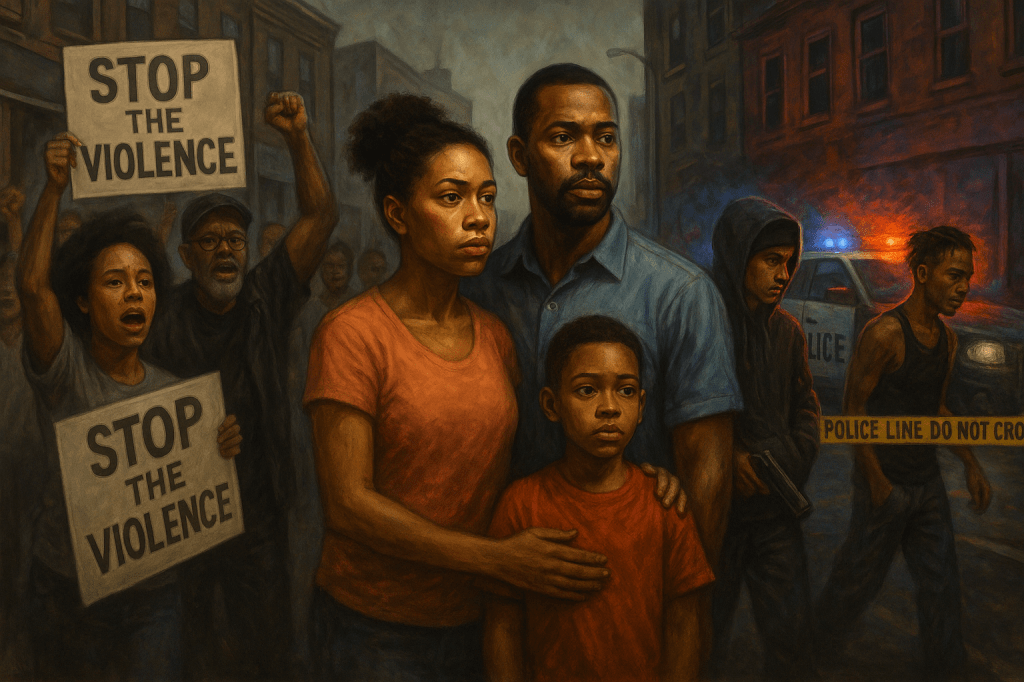
Black-on-Black Crime: Why It’s Rising and Why We Must Face It
Introduction
Today I’d like to talk about black-on-black crime—specifically, why it’s rising and why it’s being ignored.
Across the U.S., COVID restrictions are easing or disappearing. At the same time, many of us are realizing that black-on-black crime is increasing. This is happening despite the growth of Black Lives Matter, despite Black people uniting to speak out against systemic racism, and despite all the marches, talks, and advocacy.
Black-on-black crime is being ignored. It doesn’t seem to be on the agenda for Black America.
I’m raising this because if we ignore black-on-black crime, it will not disappear on its own.
What People Say Causes It—and Why It’s All of the Above
Some argue the origins of black-on-black crime lie in systemic racism: exclusion from wealth-building and group economics, being locked out of financial growth, and being forced into a “rat race” over limited resources within our communities.
Others say it comes from self-hate within African-American culture—an inability to build with one another, to cooperate, and to love each other as a community.
Others point to the single-mother household: the removal of the black male role model from the home; black women turning to the welfare and government systems for financial support—systems that came with conditions that pushed the black father out.
All of this is true. In reality, it’s all of the above.
Why Is It Getting Worse Now?
People say the pandemic and lockdowns caused mental health crises, poor behavior, and reduced access to services. I disagree. Mental health services exist—and have for a long time—especially in welfare-oriented, Democratic-led states.
The deeper cause—rarely discussed by BLM, the black conscious community, or within our own neighborhoods—is this: we don’t want to stand up and fix our communities.
Now add another trend: the legalization of marijuana, which I believe will further increase black-on-black crime.
The biggest issue: our moral system is gone. The Black American moral culture—rooted in religion, moral principles, and ethnocentric self-preservation—has eroded.
Culture, Music, and the Normalization of Destruction
Look at the hip-hop industry. It brought wealth to individuals in the Black community, but much of the music glorifies Black people killing each other.
Culture shapes behavior—and music shapes culture. When you listen to something all day, every day, for years, you become what you consume.
Compare this to other communities’ mainstream music. You don’t hear the same fixation on murdering one’s own people. But in a lot of Black mainstream rap, you hear exactly that: destruction by our own hands.
We’re Moving the Minute Hand on a Clock Designed Against Us
BLM pushes the government about systemic racism, but at the same time many of us are destroying each other—through music, culture, and broken social structures.
Think of a clock: they set the hour hand, and we are the minute hand. Our own self-hate moves that minute hand forward.
The South Sudan Example
Consider Sudan. The Muslim north fought the Christian south. Many framed it as Islam versus Christianity, but in reality it was also black-on-black hate with deep roots in African history.
When South Sudan gained independence, the funds given were exploited. The people lacked unity and structure, and soon they fought one another.
This is a warning for Black America.
What Reparations Would Mean Without Unity and Morals
If we lack moral structure and already suffer high levels of black-on-black crime, what do you think reparations would do?
History shows: funds will be exploited, organizations will hold the money, and little will reach the people.
Black-on-black crime is not just crime. It is black hatred and the absence of an ethnocentric culture that prioritizes unity.
The Youth, Culture, and Where We’re Headed
The youth shaped by today’s hip-hop culture will not be ready to receive reparations.
We’ve built a narcissistic culture—nafsī, nafsī (“me, me”). We idolize our own emotions and worship self.
If we don’t get our stuff right, we will be lost in this society, a permanent underclass, a cautionary tale for every immigrant group.
The “New Prison”
- Legalized marijuana keeping us high.
- Black women on welfare saying they don’t need men.
- Generational dysfunction planned into family structures.
- Free housing concentrated in ghettos where we vanish into ignorance.
It’s time for us to change our thinking.
My Thoughts
Black-on-black crime is tied to systemic racism, economic exclusion, self-hate, the destruction of the Black family, mass incarceration, and the erosion of moral culture.
Without unity, morals, and love for one another, outside victories will be hollow. Reparations will be wasted.
It’s on us to build an ethnocentric culture that preserves our identity, restores our moral compass, and puts each other first.
Being on Code: A Foundation for Black Unity
There are some Black people in America who show inappropriate behavior because they don’t understand what it means to be on code.
Maybe they were taught some of it in our culture—African-American culture—but because of certain phenomena, they got off track.
Think about it: the drug epidemic… the waves of crime in Black communities… systemic racism… being locked out of finances. All of this made crime seem normal in our neighborhoods. And when crime becomes the norm, people start going off code.
What Does It Mean to Be On Code?
So what does “being on code” really mean?
Even in the religion of Islam, there are codes of ethics. It’s not just Muslims dealing with Muslims; it’s also about how Muslims deal with non-Muslims in different situations. In Islam we have codes, we have etiquettes, we have manners.
But in the Black community, many of us have adopted ways of being off code. And I’ve already mentioned some of the reasons: systemic racism, drugs, poverty, crime becoming normalized.
Another part of being off code comes from self-hate. And self-hate drives us to fight one another, to tear each other down, to do things that don’t help us as a people.
A lot of this was also promoted through music, movies, and entertainment. We took criminal elements and made them into entertainment. We glorified being off code. That’s how dysfunction got pushed and promoted in our community.
Codes in Society
But here’s the thing: codes exist everywhere.
Police have codes. They have codes of ethics, codes of silence, and unwritten codes of loyalty.
Law enforcement overall runs on codes.
Courtrooms have codes. Judges have codes. Family court, criminal court, civil court—they all follow codes.
Lawyers practice by a code of ethics.
Doctors have codes of ethics about how to treat patients, what to do, and what not to do.
Teachers have codes of ethics in schools. Principals follow codes of ethics in how they lead.
Even plumbers and electricians follow codes. If you talk to a licensed plumber or electrician, ask them about the codes in their trade—they’ll tell you.
Everywhere we look in society, there are codes.
Sometimes they’re called “codes of ethics.” You see it in law, in jurisprudence. Lawyers use legal codes. Courts have codes. Doctors have codes. Teachers have codes. Everywhere you look, you’ll find codes.
Even the U.S. government itself runs on codes. The Constitution is a code.
The Constitution as a Code
The Constitution is both a code of law and a racial code.
On the surface, it looks like it’s for everyone. But in practice, there’s also a white supremacist interpretation of it. That interpretation is woven into the social fabric of America. That’s a code—white people being on code.
Think about it: when white Europeans built America’s financial system, they didn’t enslave other Europeans. They enslaved Black Africans. Why? Because they were being on code.
To advance as a race, they understood that they could not oppress or enslave other Europeans. But enslaving Africans fit within their code.
That’s being on code.
Even the Constitution itself is a code—for Europeans. That’s why, even though Black people were enslaved here for centuries, a white person can immigrate from Europe and immediately reap the benefits of white privilege.
Look at Donald Trump. His father was an immigrant, but Trump has more power and influence in America than many Black people whose ancestors literally built this country. Why? Because the Constitution works as a European code. It was designed to benefit Europeans and the European diaspora.
Other Groups On Code
And it’s not just whites. Other groups also stay on code.
Go to Chinatown in any city in America. Do you see non-Chinese people running businesses there? No. Why? Because the Chinese are on code. They support one another. They keep businesses in their community. They buy products from other Asians. They hire their own. That’s being on code.
Look at Arabs in Black neighborhoods. When they open businesses in our communities, who do they hire? Other Arabs. Rarely do you see Black employees. That’s them being on code.
Every society, every community, every group—no matter where you look—has codes. Whether they’re cultural, institutional, or professional, they stick to their codes.
The U.S. government has codes. The Constitution is a code. And not just the written Constitution, but the white supremacist interpretation of it—that’s a code too.
Why Black People Must Get On Code
But when we look at ourselves as Black people, too many of us are off code.
Being on code doesn’t just mean buying from a Black business once in a while. No. It has to go deeper than that.
We need a comprehensive code of ethics that covers every area of our lives:
A code for how we do business with one another.
A code for marriage, family, and raising children.
A code for how we live together as neighbors.
A code for how we resolve conflict without destroying each other.
A code for how we preserve our culture, identity, and community.
If we don’t establish and follow our own codes, we will never go far. Not in America, not in any society.
Codes are the backbone of strength. Every other group has them. That’s why they succeed, build wealth, and preserve their communities.
Until we, as Black people, get on code, we will remain divided, exploited, and weakened.
That’s why I say: we must get on code.


 Works of Abul Baraa Muhamad Amreeki
Leave a comment