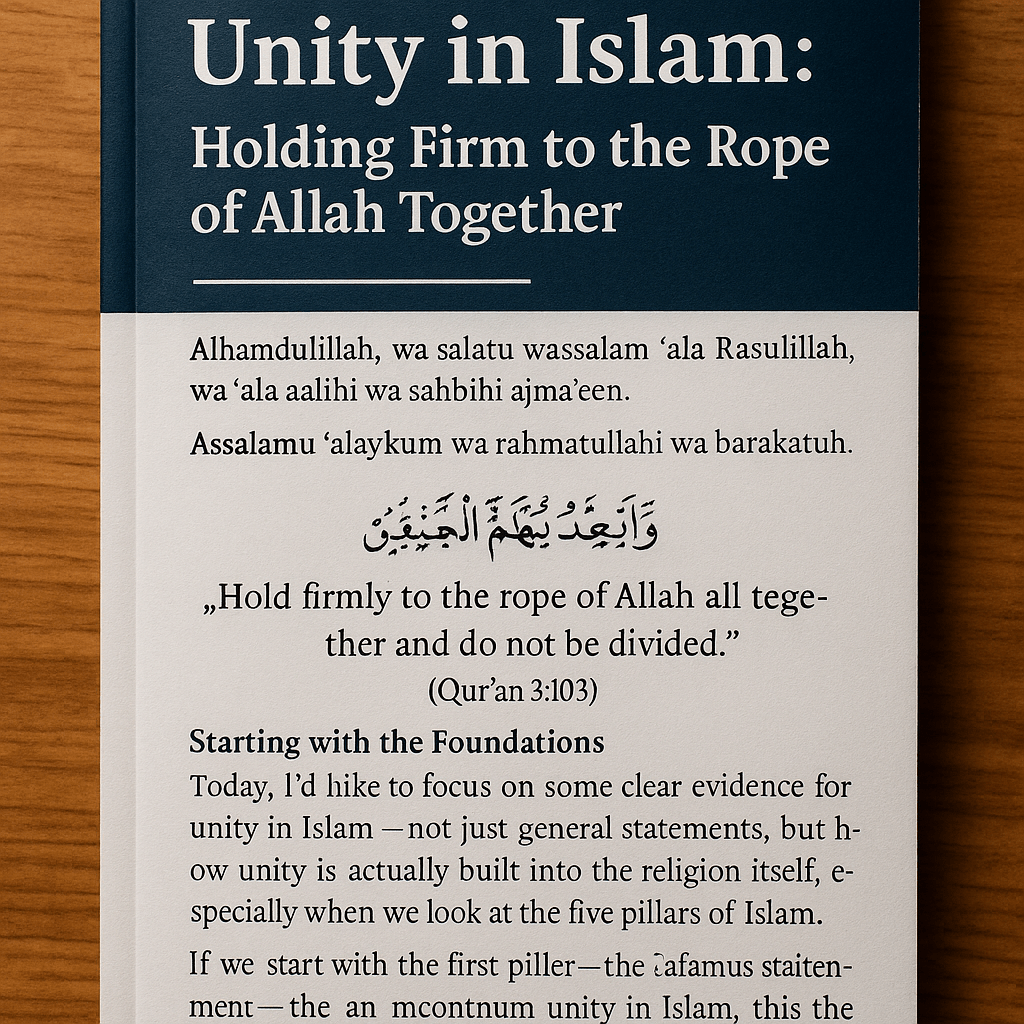
Alhamdulillah, wa salatu wassalam ‘ala Rasulillah, wa ‘ala aalihi wa sahbihi ajma‘een.
Assalamu ‘alaykum wa rahmatullahi wa barakatuh.
Today, in shaa Allah, we are going to continue our discussion about unity in Islam. In my last talk on this topic, I mentioned some verses from the Qur’an — some basic, but very important verses — that show the command for unity.
For example, Allah ﷻ says:
وَاعْتَصِمُوا بِحَبْلِ اللَّهِ جَمِيعًا وَلَا تَفَرَّقُوا
“Hold firmly to the rope of Allah all together and do not be divided.” (Qur’an 3:103)
And He ﷻ also says:
إِنَّمَا الْمُؤْمِنُونَ إِخْوَةٌ فَأَصْلِحُوا بَيْنَ أَخَوَيْكُمْ
“Indeed, the believers are but brothers, so make peace between your brothers.” (Qur’an 49:10)
These are not just beautiful statements — they are commands.
Starting with the Foundations
Today, I’d like to focus on some clear evidence for unity in Islam — not just general statements, but how unity is built into the religion itself, especially when we look at the five pillars of Islam.
1. The Shahada
The first pillar — the Shahada, the declaration of faith — is the first and most important step into Islam:
أشهد أن لا إله إلا الله وأشهد أن محمداً رسول الله
“I bear witness that there is no deity worthy of worship except Allah, and I bear witness that Muhammad is the Messenger of Allah.”
When a person says the Shahada, they immediately enter the fold of Islam. And by entering Islam, they also enter into the Ummah of Muhammad ﷺ — united with other Muslims regardless of nationality, race, or language.
The Prophet ﷺ said:
“There is no superiority of an Arab over a non-Arab, nor of a non-Arab over an Arab, nor of a white person over a black person, nor of a black person over a white person — except by taqwa.” (Musnad Ahmad)
Unity here is built on tawheed and taqwa, not race, tribe, or wealth.
One Lord, One Messenger, One Book
Our unity is reinforced by the fact that:
- Our Lord is One:
قُلْ هُوَ ٱللَّهُ أَحَدٌ — “Say: He is Allah, One.” (Qur’an 112:1) - Our Messenger is One: Muhammad ﷺ is the final Messenger sent to all mankind.
Allah says: وَمَا أَرْسَلْنَاكَ إِلَّا كَافَّةً لِلنَّاسِ
“And We have not sent you except to all of mankind.” (Qur’an 34:28) - Our Book is One: The Qur’an is the same for all Muslims, preserved without change.
One Lord, one Prophet, one Book — one Ummah.
2. Salah (Prayer)
We all pray to the same Lord, in the same way, facing the same Qiblah, reciting the same Qur’an.
For men, it is highly recommended to pray in jama‘ah (congregation) in the masjid. The Prophet ﷺ said:
“Prayer in congregation is twenty-seven times better than prayer alone.” (Bukhari & Muslim)
Standing shoulder to shoulder in Salah — rich and poor, black and white — is a living image of Islamic unity.
3. Zakat
Zakat takes from those who have wealth and gives to those in need. It builds a sense of responsibility and care.
The Prophet ﷺ said:
“The believers, in their mutual love, mercy, and compassion, are like one body: when any limb aches, the whole body reacts with sleeplessness and fever.” (Bukhari & Muslim)
Zakat keeps that body alive and healthy.
4. Sawm (Fasting) in Ramadan
Fasting is done in the same month for everyone — not whenever we choose.
We all start together, break together, and celebrate Eid together. Allah says:
فَمَن شَهِدَ مِنكُمُ ٱلشَّهْرَ فَلْيَصُمْهُ
“So whoever among you witnesses the month, let him fast it.” (Qur’an 2:185)
5. Hajj
Perhaps the greatest display of unity. Millions gather in Makkah, wearing similar clothes, performing the same rites, answering the same call:
لبيك اللهم لبيك، لبيك لا شريك لك لبيك
No status, no titles — just servants of Allah.
Our Qiblah — A Constant Reminder of Unity
Wherever we are in the world, we face the Ka‘bah. We don’t have multiple directions for prayer — we have one.
The Challenge of Western Individualism
Living in the West can make unity harder. The culture teaches “me first” — independence without responsibility.
But Islam teaches togetherness: praying together, fasting together, giving together, traveling together for Hajj.
The Problem of Disunity
Disunity often comes from:
- Lack of knowledge — or worse, half-knowledge.
- Quarrelling and disputes — Allah warns:
وَلَا تَنَازَعُوا فَتَفْشَلُوا وَتَذْهَبَ رِيحُكُمْ
“And do not dispute, lest you lose courage and your strength departs.” (Qur’an 8:46)
When we fight each other, we become weak and lose respect in the eyes of the world.
Knowledge and Action Go Together
The scholars said:
- Knowledge without action is like a tree without fruit.
- Action without knowledge leads to misguidance.
Unity needs both — learning Islam and living Islam together.
Conclusion
Unity is built into every part of Islam:
- One Lord
- One Prophet
- One Book
- One Qiblah
- Five pillars with collective dimensions
If we hold onto these, we will be strong. If we abandon them, we will be weak.
May Allah unite our hearts, remove division, and make us work together for His sake.
وَصَلَّى اللَّهُ عَلَى نَبِيِّنَا مُحَمَّدٍ، وَعَلَى آلِهِ وَصَحْبِهِ أَجْمَعِينَ
By Abul Baraa Muhammad Amreeki




 Works of Abul Baraa Muhamad Amreeki
Leave a comment