
All the praises is for Allah the Lord of the Worlds and peace and blessings be upon His Chosen Messenger Muhammad and upon his family and his companions all of them.
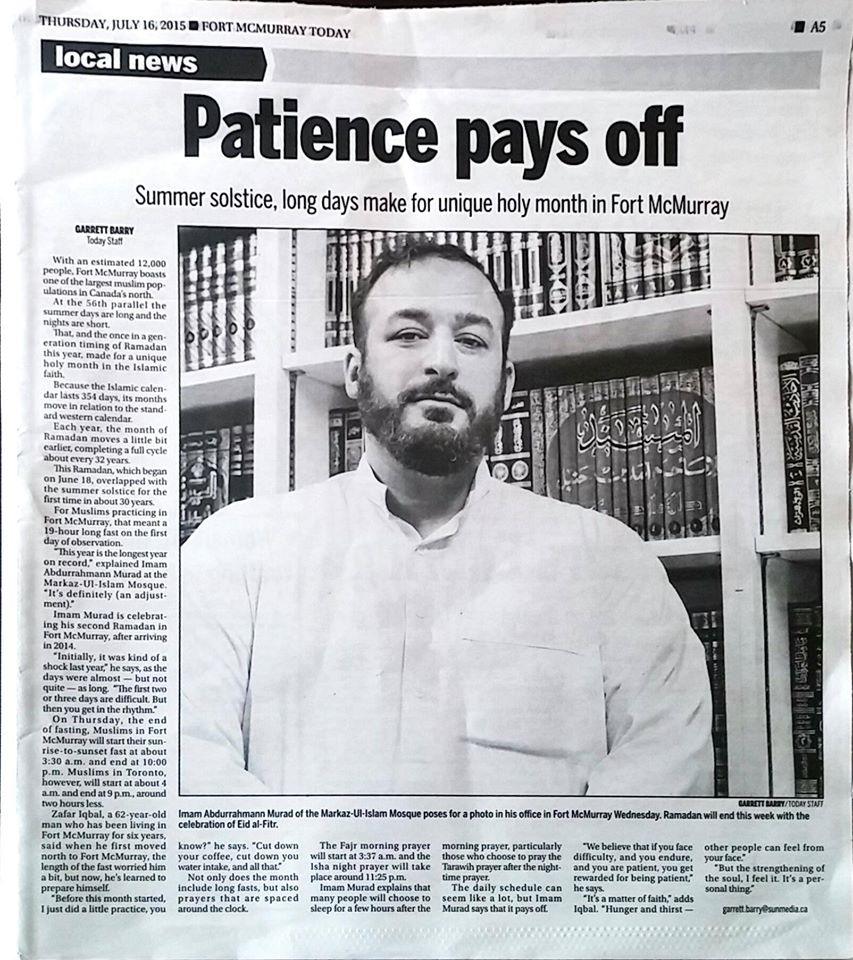
By the Student of Knowledge, Shaykh Abdurrahman Murad هداه الله
Salafi – Salafiyyah What does it mean? Honestly, I wouldn’t have written this message, but the ignorance of many in relation to this is simply PROFOUND. What provoked me to write this, is what some individuals wrote about this issue…they explicitly said: ‘Salafis hate the Four Imams!’ as well another wrote ‘Salafis have invented a new Madth’hab’…I mean ‘REALLY’?
Ok…the word today ‘Salafi’ has been profusely abused by people on ‘both ends of the spectrum’…many who claim to be ‘Salafi’ are actually quite ignorant of what this term means…and are among the greatest Muqal’ideen (blind followers) even without realizing it! They become blind followers of this Shaykh or that Shaykh who would actually issue Fatwa based deeply from within one of the Four Madth’hab…and these ‘blind followers’ will uphold their views as being in a higher prominence then the Qur’an and Sunnah. They will even discredit and possibly impute innovation to the statements of classical Muslim scholars without realizing it!
So let me be clear, I am NOT talking about these ’Salafis’…I am talking about the term as it is…a legal term and what it actually implies.
The word Salafi, implies reverence/respect/love/passion to our Salaf. The word ’Salaf’ means:
the pious predecessors, who include the first three generations of Muslims. The Prophet, may Allah praise him, is the Imam of the Salaf in this sense. The Companions are also included in this term as are the Tabiee and the Tabi’ee at-Ta’bieen.
We dearly love, revere and respect the scholars of Ahlus-Sunnah wal-Jama’ah in these generations, may Allah be pleased with them all…Ameen.
Now, I will be saying something that may be somewhat controversial, but it has to be said. There is NO student of knowledge anywhere in the world today who graduates from an institution in the Muslim world except that he has studied and graduated from a Madth’hab basis.
If one is learning in Saudi, they will graduate as ‘Hanbali’,
If one graduates from Ash-Sham or the Indian subcontinent, they will be Hanafi,
If one graduates from Egypt or Malaysia, they will be Shafi’ee,
If one graduates from Sudan, they will be Maliki.
Its that simple.
Before anyone gets anxious…let’s ask ourselves…what is the purpose of the Madth’hab? What is its primary function and goal?
You would agree with me that the Madth’hab is designed for one to emulate the example of our beloved Prophet, may Allah praise him. The Imams made it easy for us by giving us a chapter by chapter breakdown of how the Prophet was.
Now a student of knowledge who has the grasp of what he has studied will encounter an issue…at times, as students of knowledge, we will encounter Hadeeth that are very clear and authentic…but the Madth’hab states something opposite to it. What should we do? As a student of knowledge, one is obliged to follow the Hadeeth. When we do this, it will not make us ‘without a madth’hab’ nor will we ‘fall between the cracks’ smile emoticon.
So the next issue…what makes you Hanafi, Shafi’ee, Maliki, Hanbali student of knowledge?
It is the principles and Usool of the Madth’hab that you apply that will make you a follower of a Madth’hab.
Look at Imam Abu Yousef, may Allah have mercy on him. He was the companion and prominent student of Imam Abu Hanifah. Yet, he left his Imam’s view in relation to the Takbeer of the Eid prayer for the stronger opinion. This didn’t make him a ‘lesser’ Hanafi; as he wasn’t blinded by such terms and labels. He was on a mission to emulate the Prophet, may Allah praise him. That is how we should be…!
So back to the issue of Salafi…it is in essence the one who follows the ethics, conduct, example and manner (yes this also includes the manhaj) of the Salaf. Let’s go back and examine how they were…what mannerisms they upheld…and how they were with those who differed from them.
The last point I want to make on this is that one shouldn’t boastfully put others down, ‘I am a salafi, and you are not…’ this is downright ridiculous, as I have mentioned before…many who claim to be Salafi, are actually ignorant of what the term is and what it refers to. May Allah protect us all…ameen
On Fellowship…What am I? This is in relation to one who hasn’t studied Islam academically…what are they (in relation to a Madth’hab)?
You will be a follower of your Shaykh…I mean the person you usually ask info from.
If the Shaykh you lean on for guidance is a Hanbali…most likely you too will be a Hanbali…etc. This type of ‘fellowship’ is the safest for an average brother/sister who doesn’t have the time to study.
Now the bad ‘fellowship’ is in relation to one who blindly follows the internet…here there is no uniformity…one day with this site, the next with another…the next who knows what…A’oodthubillah.
One has to be careful…avoid the mess that’s out there!
It has been said...’Whoever has no Shaykh, his Shaykh is Satan‘. Although there is major ‘nadhar’/issues with this statement…it is to an extent true. For the one who picks up bits and pieces from everywhere…will eventually start looking for what is easiest and most convenient…and it is here that the statement can be seen as a certain truth.
We seek refuge with Allah! Ameen
Question was post to Shaykh Abdurrahman Murad via Facebook.



 Works of Abul Baraa Muhamad Amreeki
Leave a comment